

Biometry: measuring for your tailor-made implant
Before cataract surgery, biometry measures your eye to the hundredth of a millimetre to calculate the exact power of the implant that will replace your lens.
Eye biometry: the essentials in 30 seconds
- What is it? A contact-free measurement of the eye (length of the eye, curvature of the cornea, anterior chamber) used to calculate the implant before cataract surgery.
- Duration: a few minutes for both eyes, painless, no dilation.
- Driving afterwards? Yes, your vision remains normal.
- Cost: the fee is given to you before the test; biometry is a procedure covered by the Assurance Maladie (French national health insurance), with any additional amount covered by your mutuelle (supplementary health insurance). See fees and reimbursement.
What is eye biometry?
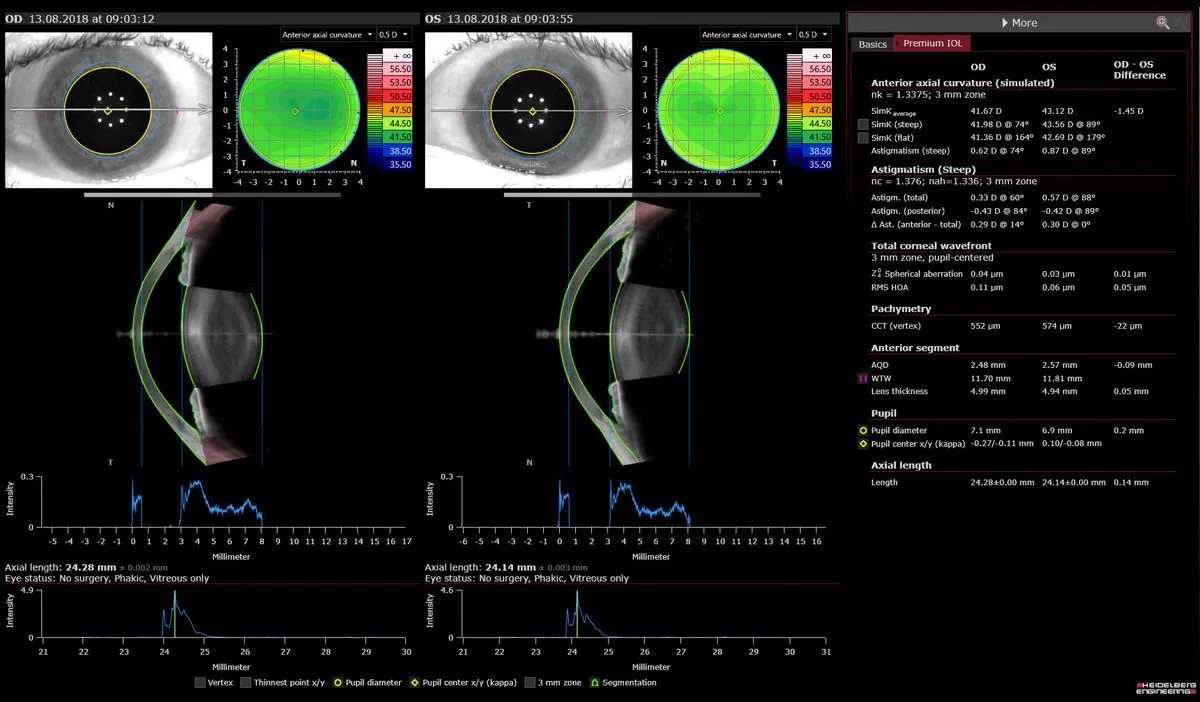
Biometry measures the precise dimensions of your eye by optical interferometry — a beam of light, with no contact at all. Three key measurements:
What is it for? Calculating your implant
These measurements feed latest-generation calculation formulas that determine the power of the intraocular implant placed during cataract surgery. It is this precision that makes it possible to aim for the goal agreed with your surgeon: clear distance vision without glasses, or more complete independence from glasses with an EDOF or trifocal implant.
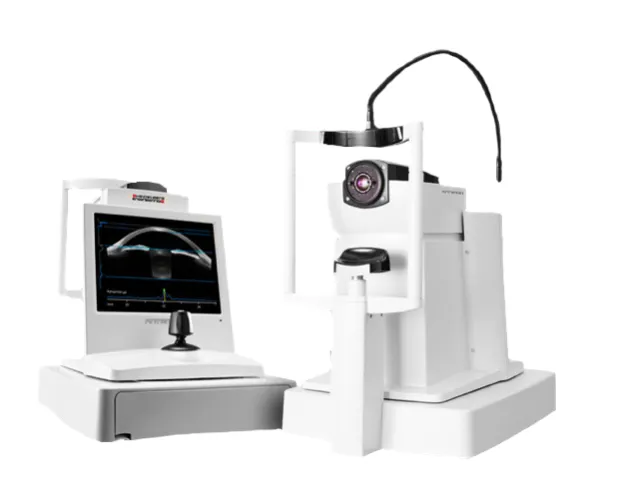
The practice's Anterion biometer also analyses the anterior segment of the eye in fine detail — an advantage for complex cases: high myopia, previously operated corneas (history of refractive surgery), significant astigmatism requiring a toric implant.
What happens during the examination?
Biometry in Noisy-le-Grand
The Grand Paris Ophtalmologie practice performs biometry on site, during the pre-operative cataract assessment, for patients from Noisy-le-Grand and eastern Paris (93, 94, 77): Bry-sur-Marne, Villiers-sur-Marne, Champs-sur-Marne, Chelles, Torcy and Marne-la-Vallée, as well as Le Perreux-sur-Marne, Nogent-sur-Marne, Fontenay-sous-Bois, Vincennes, Saint-Maur-des-Fossés, Créteil, Montreuil and Rosny-sous-Bois. The test is interpreted by Dr Yaïr Chetrit or Dr Mayer Srour — the same doctor who will operate on you.
Biometry: your questions answered
Answers from Dr Yaïr Chetrit and Dr Mayer Srour, ophthalmologists in Noisy-le-Grand.
Is eye biometry painful?
No — optical biometry is performed with no contact at all with the eye: you simply look at a light target for a few seconds per eye. No anaesthetic, no dilation.
Why is it so important before cataract surgery?
Because it determines the power of the implant that will replace your lens: the accuracy of the measurement directly determines the quality of your vision after the operation.
Do I need to remove my contact lenses beforehand?
Yes: contact lenses temporarily distort the cornea and would skew the keratometry. Remove them several days before the test, according to the practice's instructions.
Can I drive after biometry?
Yes — the test requires no dilation: you leave as normal, with no visual discomfort at all.
How much does eye biometry cost? Is it reimbursed?
The fee is given to you before the test. Biometry is a procedure covered by the Assurance Maladie (French national health insurance; Carte Vitale accepted, tiers payant — direct billing — on the Sécurité sociale portion); any additional amount is generally reimbursed by your mutuelle (supplementary health insurance). Details of our fees are on the fees and reimbursement page.
Is biometry needed before every cataract operation?
Yes, always: it determines the power of the implant. An inaccurate biometry results in stronger glasses after the operation. At the practice, it is performed with the Anterion, a latest-generation optical biometer, and supplemented if needed by corneal topography, in particular for a toric or multifocal implant.
Related reading
Have you been prescribed biometry?
The test is performed at the Noisy-le-Grand practice, during your pre-operative assessment.
The Grand Paris Ophtalmologie practice in Noisy-le-Grand provides consultations, screening and surgery for patients from neighbouring towns: