

Laser surgery or refractive surgery
Laser refractive surgery corrects myopia, hypermetropia, astigmatism and presbyopia to reduce or eliminate dependence on glasses. For patients from Seine-Saint-Denis (93), Val-de-Marne (94) and Seine-et-Marne (77), the eligibility assessment (corneal topography, pachymetry, aberrometry) and all post-operative follow-up take place at the Noisy-le-Grand practice; the operation, in LASIK or in PKR/TransPRK (no-contact surface laser), is performed by Dr Mayer Srour (Institut Voltaire, Paris 11th) or by Dr Yaïr Chetrit (Centre Laser Victor Hugo, Paris 16th); SMILE is not offered. The operation is scheduled within 15 days to a month of the assessment. The prices are detailed below and a quote (devis) is given after the assessment.
Live without glasses or contact lenses: refractive surgery corrects your vision lastingly with a laser. Full assessment at the Noisy-le-Grand practice by Dr Srour and Dr Chetrit.
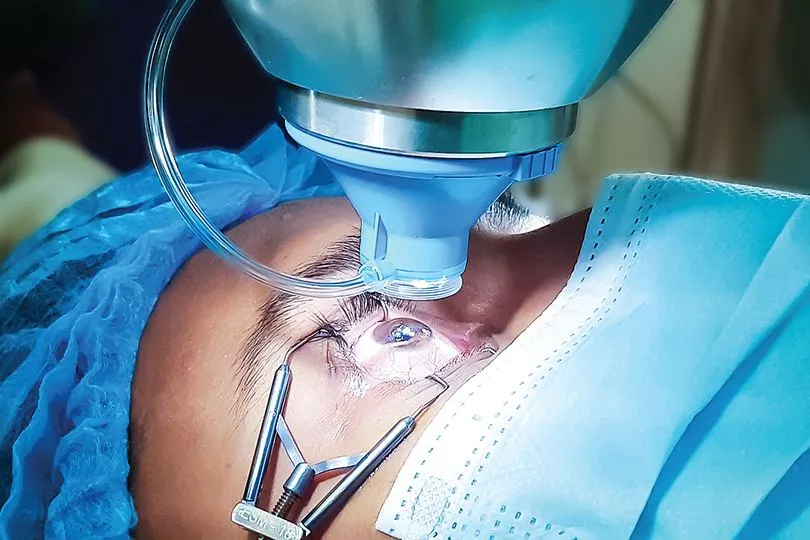
Refractive surgery: the essentials in 30 seconds
- Close to home (93, 94, 77): assessment and follow-up in Noisy-le-Grand, operation by Dr Srour in Paris 11th; 1 300 to 1 500 € per eye all inclusive, retouch included for 12 months.
- The laser corrects myopia, hypermetropia, astigmatism and presbyopia in most adults with stable vision.
- It all starts with an eligibility assessment (corneal topography, corneal thickness) carried out at the practice.
- A procedure of a few minutes per eye; functional vision from the next day for LASIK, within a few days for PKR (TransPRK, no-contact surface laser).
- Operated within 15 days to a month: this is the interval between the eligibility assessment and the operation.
- Alternatives if laser is not suitable: phakic implants (ICL).
Refractive surgery at a glance
The essentials to know before your operation, in 6 simple points.
What is refractive surgery, and who is it for?
The aim of refractive surgery is to make patients independent of glasses and contact lenses, by lastingly correcting the refractive error with a laser: myopia, hypermetropia, astigmatism or presbyopia.
To be eligible, you must be at least 21 years old and have a refractive error that has been stable for at least 2 years. If these conditions are met, additional tests assess the condition of the cornea and rule out any contraindication.
The pre-operative assessment
Beyond a careful history and clinical examination — ruling out significant dry eye or any associated condition — the assessment relies on in-depth examinations of the cornea, carried out on the practice's technical platform: measurement of its thickness (pachymetry) and corneal topography assessing its regularity.
The aim: to rule out definitively any contraindication to corneal surgery — in particular keratoconus, even in its early stages — and any risk of post-operative corneal ectasia. Contact lenses must be stopped several days before this assessment.
How the operation goes
The most common techniques are laser corneal surgeries: PKR and LASIK, performed by our surgeons (SMILE, a third laser technique, is not offered at the practice). Both eyes are operated on in the same session, under local anaesthesia with drops, as a day case. You are not asked to fast, and contact lenses must be stopped several days beforehand.
The choice of technique is made with your surgeon according to the results of the assessment: compare the techniques below.
After the operation
The after-effects depend on the technique. After PKR, some days of discomfort are usual — a bandage contact lens is placed while the eye heals — with more gradual visual recovery; in return, no flap complication is possible. After LASIK, recovery is quick and painless from the next day. After SMILE (a technique we do not offer), vision recovers within a few days.
In all cases, post-operative care amounts to putting in eye drops, with follow-up at the Noisy-le-Grand practice.
The first moments after LASIK: less than 10 minutes of surgery, then a patient reading the time without her glasses (video shared with her consent).
Instructions after laser refractive surgery
These instructions supplement the prescription and the report given to you on the day of the operation. The timings are indicative: your surgeon may adapt them to your case, and their instructions take precedence. Choose your technique:
After LASIK
- The same day
- Go home accompanied: do not drive.
- Keep your eyes closed and, if possible, sleep for a few hours: stinging and watering generally pass by the evening.
- Eye drops from the evening, as prescribed.
- Next day (D1)
- Check-up at the practice.
- Vision is already good; it may still fluctuate for a few weeks.
- 1st week
- Eye shields at night for 7 days.
- Antibiotic and anti-inflammatory for about 1 week.
- No water in the eyes.
- 1st month
- Never rub your eyes: the corneal flap is healing and could move.
- Preservative-free artificial tears, several times a day, sometimes for a few months.
Resuming activities
| Activity | When? |
|---|---|
| Screens, reading, television | From the next daytaking breaks and using artificial tears (you blink less in front of a screen) |
| Shower | From the next dayeyes closed, no water in the eyes |
| Hair washing | From D2head tilted back |
| Work | 2 to 3 daysdepending on comfort and the type of job |
| Driving | After approvalat the next-day check-up, if vision reaches the legal minimum; take care at night for the first few weeks (halos) |
| Eye make-up | 1 weekwith new products |
| Non-impact sport (jogging, cycling, gym) | 1 week |
| Dust, gardening | 1 weekor with protective glasses |
| Swimming pool, sea, sauna, steam room, jacuzzi | 2 weeksthen with swimming goggles |
| Contact, combat or ball sports | 1 monthideally with protective glasses |
| Flying | Alloweddry air: use your artificial tears more often |
| Sunglasses | Recommendedwhenever it is sunny |
This is normal
- Stinging, watering and sensitivity to light on the first day.
- Small red patch on the white of the eye, which disappears in 2 to 3 weeks.
- Dry eyes for a few weeks to a few months.
- Halos or glare around lights at night, which gradually lessen.
- Vision that fluctuates from one moment to the next during the first month; it stabilises in 1 to 3 months.
Seek advice without delay if…
- Pain appears or increases after the first day.
- Vision worsens suddenly.
- The eye becomes redder and redder or discharge appears.
- You have received a blow or rubbed the eye hard and vision has changed.
At the practice, Mon–Fri 8.30am–7pm: you are seen the same day, without an appointment. Emergencies are also seen between 1pm and 2pm, with no break. At night and at weekends: 24-hour eye emergencies at the Hôpital Fondation Rothschild (Paris 19th) or the Hôpital des Quinze-Vingts (Paris 12th).
Follow-up: check-up the next day, then at about 1 month and 3 months (dates specified on your report).
After PKR / TransPRK (surface laser)
- The same day
- Go home accompanied: do not drive.
- A bandage contact lens is placed on each eye: never remove it yourself.
- Eye drops and painkillers as prescribed.
- J1 à J3
- This is the most uncomfortable period: burning, watering, sensitivity to light.
- Take the prescribed painkillers, rest in dim light, wear sunglasses.
- A cold pack (in a clean cloth) placed on the closed eyelids brings relief.
- Around D4–D5
- Removal of the bandage lenses at the practice, once the surface of the eye has healed.
- The discomfort goes away; vision gradually improves.
- Following weeks
- Anti-inflammatory eye drops in tapering doses: do not stop or extend them without advice (monitoring of eye pressure).
- Vision that fluctuates, then stabilises in 1 to 3 months.
Resuming activities
| Activity | When? |
|---|---|
| Screens, reading, television | Depending on comfortpossible from D2, but often unpleasant before the lenses are removed |
| Shower, hair washing | From the next dayeyes closed, head tilted back, no water in the eyes |
| Work | About 1 weeka sick note (arrêt de travail) can be provided |
| Driving | About 1 weekafter the surgeon's approval, if vision reaches the legal minimum |
| Rubbing the eyes | Forbidden for 1 monththe surface of the eye is still fragile |
| Eye make-up | 10 dayswith new products |
| Non-impact sport (jogging, cycling, gym) | 1 weekafter the lenses are removed |
| Dust, gardening | 1 weekor with protective glasses |
| Swimming pool, sea, sauna, steam room, jacuzzi | 2 weeksthen with swimming goggles |
| Contact, combat or ball sports | 1 monthideally with protective glasses |
| Flying | Alloweddry air: use your artificial tears more often |
| Sun | Sunglassesalways outdoors for at least 3 months: UV light promotes a hazy corneal scar (haze) |
This is normal
- Pain, burning and watering during the first 2 to 3 days.
- Blurred vision during the first week, which clears after the lenses are removed.
- Vision that fluctuates for a few weeks.
- Dry eyes for a few months.
- Halos or glare at night at first.
Seek advice without delay if…
- Pain increases after the 3rd day instead of easing.
- Vision worsens when it had been improving.
- The eye becomes redder and redder, or discharge appears.
- A bandage lens has fallen out or moved: do not put it back.
At the practice, Mon–Fri 8.30am–7pm: you are seen the same day, without an appointment. Emergencies are also seen between 1pm and 2pm, with no break. At night and at weekends: 24-hour eye emergencies at the Hôpital Fondation Rothschild (Paris 19th) or the Hôpital des Quinze-Vingts (Paris 12th).
Follow-up: removal of the lenses at about D4–D5, then check-ups at about 1 month and 3 months (dates specified on your report).
Instructions drawn up by Dr Mayer Srour based on the patient information sheet of the Société Française d'Ophtalmologie on laser corneal refractive surgery (SFO, 2026), the patient recommendations of the Royal College of Ophthalmologists and the American Academy of Ophthalmology, and the post-operative protocols of reference centres (Moorfields Eye Hospital, UCLA Health). Updated: September 2026.
Where does the operation take place?
The operations take place in reference laser centres in Paris, depending on your surgeon:
6 rue du Dôme — 75116 Paris
5 rue la Vacquerie — 75011 Paris
How much does refractive surgery cost?
The price has two parts: the surgeon's fees and the costs of the laser centre where the operation takes place. Prices of Dr Mayer Srour (Institut Voltaire, Paris 11th):
| Technique | Surgeon's fees | Laser centre costs | Total per eye | Total for 2 eyes |
|---|---|---|---|---|
| TransPKR (surface laser) | 1 000 € | 300 € | 1 300 € | 2 600 € |
| LASIK (femtosecond + excimer) | 1 000 € | 400 € | 1 400 € | 2 800 € |
| Presbylasik (presbyopia) | 1 000 € | 500 € | 1 500 € | 3 000 € |
| ICL implants | by quote (devis) after the assessment | |||
A retouch is included for 12 months if needed, and payment can be made in instalments. Refractive surgery is not reimbursed by the Assurance Maladie (French national health insurance); many mutuelles (supplementary health insurance) offer an allowance, and the quote (devis) given after the assessment allows you to request it.
PKR or LASIK?
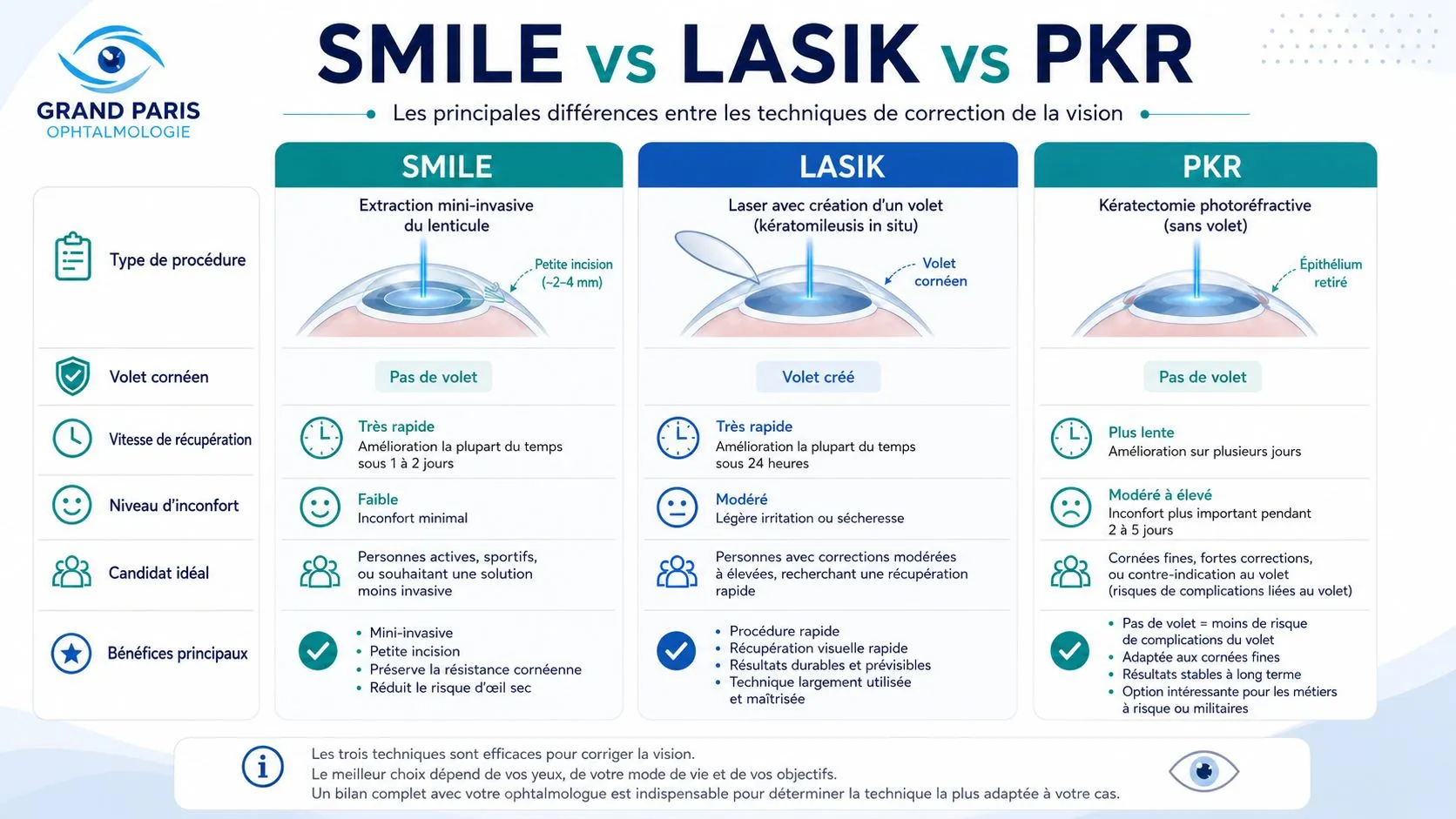
Two proven laser techniques, performed by our surgeons. The right choice depends on your cornea, your correction and your lifestyle — it is made with your surgeon, after the assessment. SMILE, a third laser technique, is described here for information: it is not offered at the practice.
The excimer laser reshapes the surface of the cornea, after removal of the epithelium. A few days of discomfort (bandage contact lens) and a more gradual recovery — but no flap complication is possible. Suitable for thinner corneas.
Two lasers combined: the femtosecond laser cuts a thin corneal flap, then the excimer laser corrects the vision; the flap is put back in place. Sharp vision from the next day, without pain. The most widely performed technique in the world.
A single femtosecond laser cuts a thin lenticule within the thickness of the cornea, removed through a micro-incision — with no flap. Vision recovers within a few days. This technique is not performed by our surgeons; it is presented here to help you compare.
LASIK, filmed in the operating theatre
Dr Mayer Srour shows how a LASIK refractive operation actually goes: cutting the corneal flap with the femtosecond laser, reshaping the cornea, then repositioning — a quick, precise and painless procedure.
Watch the video on InstagramTransPKR, filmed in the operating theatre
Dr Mayer Srour shows how a laser operation for myopia by TransPKR actually goes: placing the eyelid speculum, laser treatment, application of mitomycin with a small sponge (Merocel), then placing a bandage contact lens.
Watch the video on InstagramOfficial factsheets from the Société Française d'Ophtalmologie
Written by SFO experts, they describe how each procedure is carried out, and its benefits and risks. Please read them before your consultation.
Refractive surgery in Noisy-le-Grand and eastern Paris
The Grand Paris Ophtalmologie practice welcomes patients from Noisy-le-Grand and neighbouring towns in Seine-Saint-Denis (93), Val-de-Marne (94) and Seine-et-Marne (77): Bry-sur-Marne, Villiers-sur-Marne, Champs-sur-Marne, Neuilly-sur-Marne, Gournay-sur-Marne, Noisiel, Torcy, Chelles, Gagny and the whole Marne-la-Vallée area, as well as Le Perreux-sur-Marne, Nogent-sur-Marne, Fontenay-sous-Bois, Vincennes, Saint-Maur-des-Fossés, Créteil and Montreuil.
Dr Mayer Srour and Dr Yaïr Chetrit oversee the whole pathway close to home: complete pre-operative assessment on the practice's technical platform, surgery in reference laser centres in Paris, then post-operative follow-up at the practice. Patients from Seine-et-Marne: your pathway.
Refractive surgery: your questions
Answers from Dr Mayer Srour and Dr Yaïr Chetrit, ophthalmic surgeons in Noisy-le-Grand.
Is laser surgery painful?
Not during the procedure: the eye is numbed with anaesthetic drops. Afterwards, it depends on the technique: no pain with LASIK; a few days of discomfort with PKR, eased by a bandage contact lens.
From what age can you have the operation?
From 21 years, provided that the refractive error has been stable for at least 2 years.
Which refractive errors are corrected?
Myopia, hypermetropia, astigmatism and presbyopia. The technique is chosen according to your correction, the thickness and regularity of your cornea, your lifestyle and your occupation.
What is the difference between PKR, LASIK and SMILE?
PKR applies the laser to the surface (gradual recovery, no flap complication). LASIK combines two lasers with a thin corneal flap (recovery from the next day, without pain). SMILE extracts a lenticule through a micro-incision, with no flap (recovery within a few days). At the practice, Dr Srour and Dr Chetrit perform PKR and LASIK; SMILE is not offered. See the comparison.
How much does LASIK cost if you live in eastern Paris (93, 94, 77)?
With Dr Mayer Srour: LASIK 1 400 € per eye (2 800 € for both eyes), TransPKR 1 300 € per eye (2 600 € for both eyes); Presbylasik 1 500 € per eye. These amounts include the surgeon's fees and the laser centre costs; a retouch is included for 12 months and payment can be spread over instalments. The eligibility assessment and post-operative check-ups take place at the Noisy-le-Grand practice, the operation at the Institut Voltaire (Paris 11th).
Are both eyes operated on the same day?
Yes: both eyes are operated on in the same session, as a day case. You do not need to fast.
What are the contraindications?
An unstable correction, a cornea that is too thin or irregular (in particular keratoconus, even early), significant dry eye or certain associated conditions. The pre-operative assessment (pachymetry, topography) is there precisely to rule out any risk of corneal ectasia.
Is refractive surgery reimbursed?
No: it is so-called elective surgery, not covered by the Assurance Maladie (French national health insurance). However, many mutuelles (supplementary health insurance) offer a contribution allowance. A quote (devis) is given after the assessment. As a guide, with Dr Srour: TransPKR 1 300 €, LASIK 1 400 €, Presbylasik 1 500 € per eye, retouch included for 12 months (see the prices).
Do I need to stop wearing contact lenses beforehand?
Yes, several days before the assessment as before the operation: contact lenses temporarily change the shape of the cornea and would distort the measurements.
What precautions should I take after LASIK or PKR?
After LASIK: eye shields at night for 7 days, do not rub the eyes for 1 month, return to work in 2 to 3 days, swimming pool after 2 weeks. After PKR: 2 to 3 days of discomfort, bandage contact lens removed at the practice at around D4–D5, about 1 week before returning to work and driving, sunglasses for at least 3 months. Increasing pain or a drop in vision mean you must be seen the same day. See all the instructions.
Which lasers are used?
Dr Srour operates with the VisuMax 800 femtosecond laser (Zeiss) for cutting the LASIK flap and then with an excimer laser for reshaping the cornea (LASIK, TransPKR). SMILE is not offered.
Where can I have laser surgery if I live in the 93, 94 or 77?
The eligibility assessment and all follow-up take place at the Noisy-le-Grand practice (93160), five minutes from the A4 and the RER A. Only the operation itself takes place in Paris, at the Institut Voltaire (Paris 11th), which has the laser equipment.
Who performs the refractive surgery?
Dr Mayer Srour, who personally carries out the pre-operative assessment at the practice, the operation at the Institut Voltaire and the follow-up consultations. It is the same surgeon from start to finish, which avoids multiple contacts between the assessment and the post-operative check-up.
How many trips should I plan for?
In practice, three stages: the eligibility assessment at the Noisy-le-Grand practice, the operation in Paris (both eyes on the same day), then the post-operative check-ups at the practice. The check-up the day after the operation takes place in Noisy-le-Grand.
How soon can laser surgery be done?
Between the eligibility assessment and the operation, allow 15 days to one month at most. The assessment and all follow-up take place at the Noisy-le-Grand practice; the operation is performed by Dr Mayer Srour at the Institut Voltaire (Paris 11th). If you wear contact lenses, plan for the break requested before the assessment, which may push back the schedule.
Related reading
Want to live without glasses?
The full pre-operative assessment takes place at the Noisy-le-Grand practice. Let's talk about your plans.
The Grand Paris Ophtalmologie practice in Noisy-le-Grand provides consultations, screening and surgery for patients from neighbouring towns: