

Renewing your glasses & contact lenses
Much more than a simple update of your prescription: the renewal consultation precisely measures your vision and checks the health of your eyes. It is carried out at the practice in Noisy-le-Grand by Dr Chetrit and Dr Srour.
Renewing glasses and contact lenses: the essentials in 30 seconds
- Renewal is an opportunity for a complete check: eye pressure, fundus examination — not just the prescription.
- Validity of glasses prescriptions: 1 year before age 16, 5 years from 16 to 42, 3 years after 42; contact lenses: 1 year before age 16, 3 years thereafter.
- Quick appointment via Doctolib; the optician can readjust in some cases, but does not screen for glaucoma or retinopathy.
- Children and first prescriptions: dedicated consultation with cycloplegia if necessary.
Recommended eye screening, at every age
Many eye diseases cause no symptoms at first. These regular check-ups make it possible to detect them in time — all can be carried out at the practice.
Screening for strabismus and amblyopia: examination recommended around 9–12 months if there is a risk factor, and before age 3 for everyone — see paediatric ophthalmology.
Complete eye check before starting primary school (CP): uncorrected hypermetropia or astigmatism can hinder learning to read.
Eye check and eye examination, even without discomfort — a chance to renew glasses and contact lenses.
Screening for glaucoma (eye pressure, OCT, visual field), especially if there is a family history — and the onset of presbyopia.
Diabetes: fundus examination every year. High myopia: regular monitoring of the retina. Long-term corticosteroids, family history: tailored follow-up.
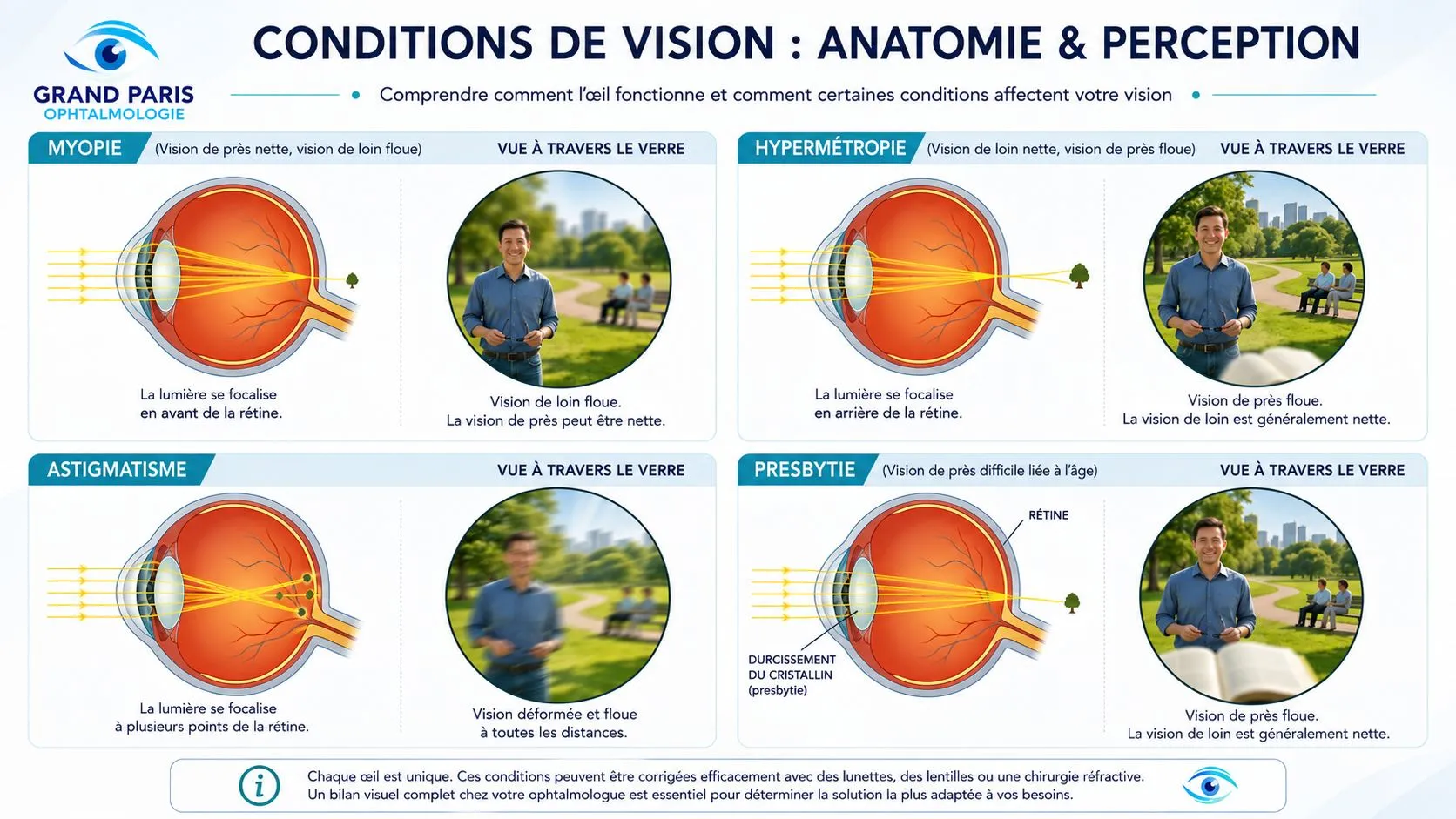
Myopia, hypermetropia, astigmatism, presbyopia: the four defects corrected
Your glasses or contact lenses correct one or more of these visual defects. Identifying them precisely is the basis of a good-quality prescription.
The eye works like a camera: the cornea and lens focus, the retina receives the image. When the image does not form exactly on the retina, vision is blurred — this is a refractive error.
The eye is « too long » or the cornea too curved: the image forms in front of the retina. At a distance, landscapes and faces are blurred; up close, vision remains clear. A short-sighted child squints and moves closer to objects. It begins in childhood or adolescence, progresses and then stabilises around 20–25; there is a family predisposition.
Corrections: diverging lenses, contact lenses, myopia control in children, laser surgery after stabilisation. High myopia (beyond −6 D) requires regular monitoring of the retina.
The eye is « too short »: the image forms behind the retina. The young eye compensates with constant accommodation effort — at the cost of headaches, eye fatigue and difficulty up close, especially at the end of the day. Common and normal in young children, it should be screened for when it is high, as it can promote strabismus or amblyopia.
Corrections: converging lenses, contact lenses, or refractive surgery in adults.
The cornea is not perfectly spherical (more « rugby ball » than « football »): vision is distorted, doubled or imprecise at all distances — confusion of similar letters (H/M/N), smudging lines. It is often associated with myopia or hypermetropia.
Corrections: toric glasses or contact lenses, laser surgery. An irregular or changing astigmatism prompts a search for keratoconus using corneal topography — carried out at the practice.
Around 45, the lens loses its elasticity and focusing up close becomes difficult: you « stretch your arms » to read, and screen work is tiring. This natural ageing affects everyone and progresses gradually until about 60–65, when it stabilises. A check roughly every 2 years allows the prescription to be adjusted.
Corrections: near-vision lenses, progressive lenses (distance + intermediate + near), multifocal contact lenses, or surgery — laser or lens surgery with multifocal implants, ideally discussed before age 55–60.
When should you renew your glasses or contact lenses?
The first signal is you: less clear vision at a distance or up close, needing to squint, eye fatigue at the end of the day, headaches in front of the screen, glare when driving at night. These signs justify a check without waiting for the prescription to expire.
But a regular check is also recommended even without discomfort — every 1 to 3 years depending on age and history. It is an opportunity to detect silent diseases (glaucoma, AMD, diabetic retinopathy) that cause no symptoms at first.
The consultation, step by step
A renewal is never a mere formality: it is a complete ophthalmological examination.
Your glasses: a prescription suited to your life
The prescription is not the same for reading, screen work or driving. We write it taking into account how you actually use your eyes: distance, near and intermediate vision, progressive lenses after 45, filters for screen work.
A well-adjusted prescription means less eye fatigue and renewed everyday comfort. If your vision has changed markedly, we look for the cause — the onset of a cataract or diabetes can alter refraction.
Your contact lenses: renewing safely
Wearing contact lenses is not trivial: before renewing the prescription, we check tolerance, the condition of the cornea and the quality of the tear film.
Soft, toric (astigmatism) or multifocal (presbyopia): the prescription is reassessed for a renewal. However, the practice does not carry out the first fitting of contact lenses or fitting for an irregular cornea (keratoconus) — this remains the remit of a specialist centre.
How long is a prescription valid?
The period of validity depends on your age. As a guide, in France:
Indicative durations, unless the doctor states otherwise. The optician may adapt the prescription during this period, within certain limits.
Renewing your glasses in Noisy-le-Grand and eastern Paris
The Grand Paris Ophtalmologie practice welcomes patients from Noisy-le-Grand and neighbouring towns (93, 94, 77): Bry-sur-Marne, Villiers-sur-Marne, Champs-sur-Marne, Neuilly-sur-Marne, Gournay-sur-Marne, Noisiel, Torcy, Chelles, Gagny and Marne-la-Vallée, as well as Le Perreux-sur-Marne, Nogent-sur-Marne, Fontenay-sous-Bois, Vincennes, Saint-Maur-des-Fossés, Créteil and Montreuil.
The eye check, measurement of your prescription and complete eye examination are carried out on site by Dr Yaïr Chetrit and Dr Mayer Srour, using the practice’s technical facilities.
Renewal: questions and answers
Answers from Dr Yaïr Chetrit and Dr Mayer Srour, ophthalmologists in Noisy-le-Grand.
When should you renew your glasses or contact lenses?
As soon as vision becomes less clear, in the event of eye fatigue, headaches or glare — and without waiting, when the prescription is due to expire. A regular check (every 1 to 3 years) is also recommended even without discomfort, to detect silent eye diseases.
Does renewal require a complete examination?
Yes. Beyond measuring the prescription, the consultation includes a complete eye examination (eye pressure, cornea, lens, fundus): it is an opportunity to detect conditions without symptoms early.
Can I renew my contact lenses without a new examination?
Renewing contact lenses requires a check of tolerance and of the condition of the cornea. The prescription is renewed after checking the fit, the prescription and the health of the ocular surface.
How long is my prescription valid?
For glasses: about 1 year before age 16, 5 years from 16 to 42, 3 years after 42. For contact lenses: 1 year before age 16, 3 years thereafter. Indicative durations, unless the doctor states otherwise.
My vision has changed, is that normal?
The prescription changes with age — myopia may progress, presbyopia appears around 45. But a rapid or significant change should be examined: it may reveal a cataract, diabetes or another condition.
Do I need a recent prescription to order glasses?
Yes: the optician needs a prescription that is still valid to supply your glasses and have them reimbursed. If yours has expired, a consultation allows a new one to be written and your eyes to be checked.
Related reading
Time to renew your vision?
Eye check and complete eye examination at the practice in Noisy-le-Grand.
The Grand Paris Ophtalmologie practice in Noisy-le-Grand provides consultations, screening and surgery for patients from neighbouring towns: