

Ophthalmologist for children in Noisy-le-Grand: paediatric ophthalmology
A child’s vision develops during the first years of life: this is the period when everything is decided. An undetected problem can leave a lasting amblyopia (lazy eye). At the Noisy-le-Grand practice, Dr Mayer Srour and Dr Yaïr Chetrit, with the orthoptist, provide screening and visual follow-up for children from a very young age.
The essentials in 30 seconds
- From what age? The practice sees children from age 3. The screenings recommended for everyone (around age 1, at 3-4 years and before age 6) remain valid even if the child has no complaints; before age 3, we refer you to the ophthalmology department of the CHI de Créteil.
- Is a prescription needed? No: ophthalmologists can be seen directly, without going through your GP (médecin traitant), and the child’s consultation is reimbursed by the Assurance Maladie (the French national health insurance).
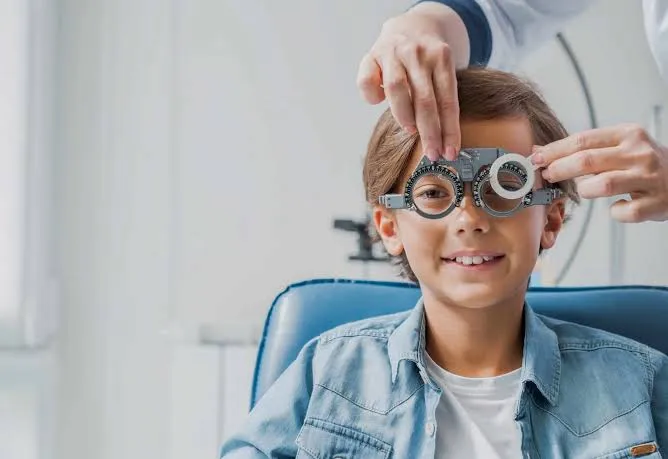
- How does the examination go? Games and pictures to measure vision, a study of eye movements, then a measurement of refraction after eye drops (cycloplegia): 30 to 60 minutes, painless.
- Where to go? At the Grand Paris Ophtalmologie practice, 67 rue de Malnoue in Noisy-le-Grand, 10-20 minutes from Champs-sur-Marne, Chelles, Torcy, Villiers, Bry or Neuilly-sur-Marne. Book on Doctolib or call 01 85 10 57 00.
Why screen a child’s vision early?
In children, vision is not yet complete at birth: it develops during the first years, as the brain learns to use both eyes. This is a sensitive period: if one eye sees poorly (refractive error, squint, an obstacle on the visual axis), the brain may “set it aside”.
This neglected eye does not develop normal vision: this is amblyopia. Detected early, it responds very well to treatment; but after age 6, the ability to recover becomes limited. Yet a child almost never complains: they do not know they see poorly with one eye. Hence the importance of regular screening, even without symptoms.
The three key ages for screening
Three screening appointments are recommended for all children — they can be done by the GP (médecin traitant), the paediatrician or the ophthalmologist. The practice sees children from age 3. Before age 3, we refer you to the ophthalmology department of the CHI de Créteil.
In cases of family history (squint, high myopia or hypermetropia, amblyopia) or a warning sign, the examination should be done as a priority by an ophthalmologist, without waiting for the “theoretical” screening age.
Warning signs
A child does not say they see poorly. It is often parents or school who notice unusual behaviour. Consult if you notice:
Many of these signs suggest a squint or a refractive error such as myopia. If you notice any of them, an eye examination is needed without waiting for the next screening.
How does the consultation go?
The examination is always adapted to the age of the child, to their cooperation and to the points raised during the discussion with the parents. It is done gently, often as a game.
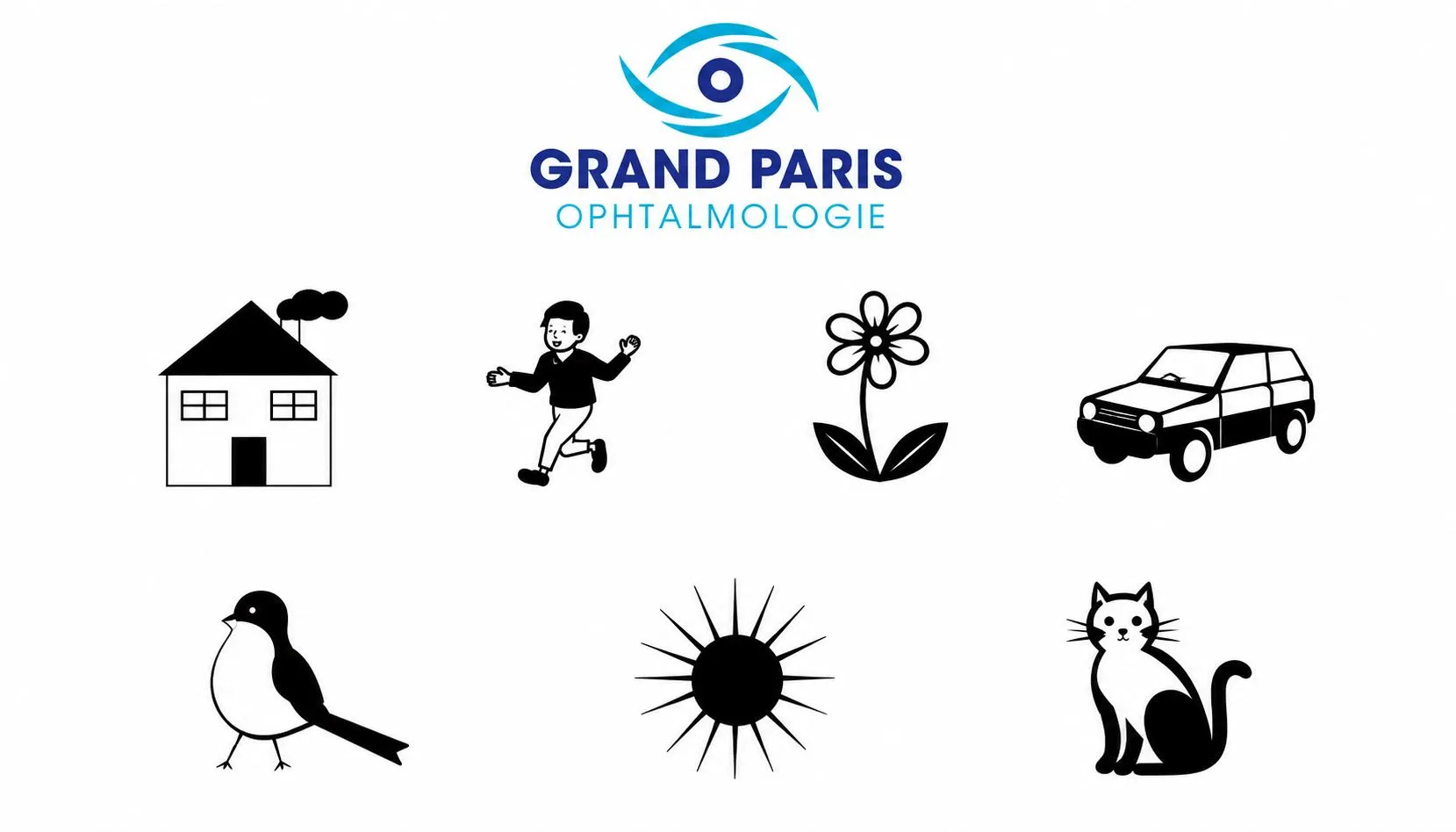
Before they can read letters, children name pictures. We use charts with pictograms (such as the Pégassou chart): drawings presented in decreasing sizes to measure the acuity of each eye, at distance and near.
In some cases (high prescription, squint, family history), we instil eye drops that relax accommodation — very powerful in children — in order to measure the exact correction and to see the fundus and lens clearly. Vision remains blurred for a few hours afterwards. This examination is only carried out when it is useful.
💡 Before age 6, we prefer morning appointments, when the child cooperates best. For children who wear glasses, an annual check is recommended. Find out how a first consultation generally goes.
What we screen for and manage
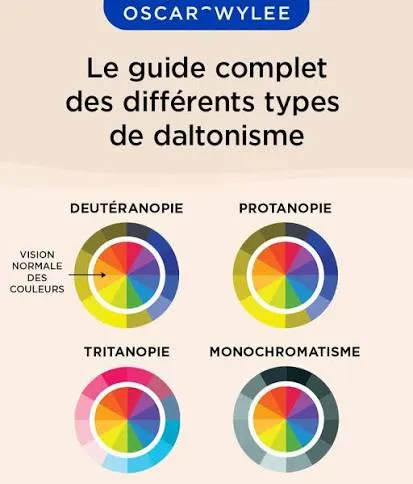
The paediatric consultation makes it possible to identify and follow the main conditions affecting a child’s vision:
The right reflex: don’t wait for the child to complain. Screening at the key ages, and a consultation at the slightest sign, are most often enough to preserve all of the child’s sight.
Your child’s vision: good habits
Screening at around 1 year, 3-4 years and 6 years, even without symptoms: a child does not say they see poorly.
Squint, high myopia or amblyopia in the family: see an ophthalmologist without delay.
Eye that turns, head tilted, child moving closer: a white reflex in the pupil is an emergency.
Before age 6, children cooperate better in the morning. For children who wear glasses, an annual check is recommended.
Official factsheets from the Société Française d'Ophtalmologie
Written by SFO (French Society of Ophthalmology) experts, they detail the child’s eye examination, squint and amblyopia. To be read before the consultation.
Paediatric ophthalmology in Noisy-le-Grand
The Grand Paris Ophtalmologie practice provides screening and visual follow-up for children, with the orthoptist, for families from Noisy-le-Grand and eastern Paris (93, 94, 77): Bry-sur-Marne, Villiers-sur-Marne, Champs-sur-Marne, Neuilly-sur-Marne, Gournay-sur-Marne, Noisiel, Torcy, Chelles, Gagny, Marne-la-Vallée, but also Le Perreux-sur-Marne, Nogent-sur-Marne, Vincennes, Saint-Maur-des-Fossés, Créteil, Rosny-sous-Bois and Montreuil.
Dr Mayer Srour and Dr Yaïr Chetrit see children from age 3, with an age-appropriate examination and in liaison with the paediatrician or GP (médecin traitant). Before age 3, we refer you to the ophthalmology department of the CHI de Créteil.
Your child’s vision: your questions
Answers from Dr Mayer Srour and Dr Yaïr Chetrit, ophthalmologists in Noisy-le-Grand.
From what age should I take my child to the ophthalmologist?
Three key ages are recommended for all children: around 1 year, between 3 and 4 years, and around 6 years (starting school). The practice sees children from age 3; before this age, we refer you to the ophthalmology department of the CHI de Créteil. If there is a family history or a warning sign, do not wait.
Why screen so early?
Vision develops during a sensitive period. An uncorrected problem can leave an amblyopia, from which recovery becomes limited after age 6.
What signs should alert me?
An eye that turns, a child who closes one eye, moves closer, tilts their head, or a white reflex in the pupil (emergency). A family history also calls for an ophthalmological opinion.
How does the consultation go?
An orthoptist carries out a pre-examination, vision is measured with an auto-refractometer (+ a reading test at verbal age), and a motor assessment evaluates the deviation and depth perception.
What is refraction under cycloplegia?
A measurement of vision after eye drops that relax accommodation, to obtain the exact correction. Vision then remains blurred for a few hours.
Do the eyes always have to be dilated?
No, it is not routine. Dilation is indicated in cases of high prescription, squint or family history, and to examine the fundus. The ophthalmologist decides case by case.
When is a good time to take a child to the ophthalmologist?
Before age 6, preferably in the morning, when the child cooperates best. For children who wear glasses, an annual check is recommended.
My child sees well and does not complain: do they still need a vision screening?
Yes. A child does not know they see poorly with one eye and adapts without saying anything. That is precisely why screening at the key ages is essential, even without symptoms.
Do I need a referral to see a paediatric ophthalmologist?
No. Ophthalmologists are among the specialists you can see directly: you can book an appointment for your child without going through the GP (médecin traitant) or the paediatrician, and the consultation is reimbursed as normal. A letter from the paediatrician or the PMI (the French maternal and child health service) is useful but not compulsory.
Where can I find an ophthalmologist for my child near me in Seine-Saint-Denis or Seine-et-Marne?
The Grand Paris Ophtalmologie practice in Noisy-le-Grand (93) sees children from all over eastern Paris: Champs-sur-Marne, Chelles, Torcy, Noisiel, Gagny, Neuilly-sur-Marne, Villiers-sur-Marne, Bry-sur-Marne and beyond. Noisy-Champs RER A station is a 15-minute walk away, there is parking nearby, and appointments are booked on Doctolib.
My child is myopic: can the progression of their myopia be slowed?
Yes. In children, the progression of myopia can be slowed by myopia-control glasses or lenses, low-dose atropine eye drops and more time spent outdoors. Follow-up every 6 to 12 months allows the treatment to be adjusted.
From what age can a child wear glasses?
From the first months of life if correction is needed: paediatric frames are designed for babies. The earlier the correction is put in place, the better vision develops.
Do you see children under 3?
No, the practice sees children from age 3. Before this age, we refer you to the ophthalmology department of the Centre Hospitalier Intercommunal de Créteil (CHI de Créteil). Do not wait if there is a white reflex in the pupil, trembling eyes, an eye that turns constantly, or watering with fear of light.
Related reading
Doubts about your child's vision?
Screening and visual follow-up for children at the Noisy-le-Grand practice — age-appropriate examination, with the orthoptist.
The Grand Paris Ophtalmologie practice in Noisy-le-Grand provides consultations, screening and surgery for patients from neighbouring towns: