
Back to school: screening for children's vision problems
A child who cannot see well almost never complains: they assume everyone sees the way they do. The signs to look for, the key ages for screening and what the examination involves.
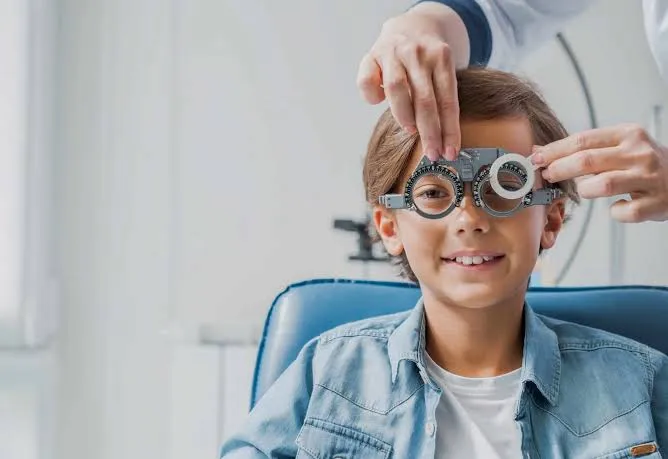
The start of the school year is when children's vision problems come to light most often. In class, children have to read from the board, follow a line of writing and switch between near and distance all day long: a visual defect that went unnoticed over the holidays suddenly becomes a problem.
Why a child almost never complains
This is the most important point to understand: a child who cannot see well does not know it. They have nothing to compare with and consider their vision normal. They compensate — by moving closer, squinting, avoiding tiring activities — rather than alerting their parents. This is especially true when only one eye is affected: the good eye completely masks the deficit in the other.
Hence the value of systematic screening, even when there is no complaint.
Signs that should prompt a consultation
- they move closer to the board, the television, the notebook or the screen;
- they squint, close one eye or tilt their head to look at things;
- they complain of headaches at the end of the day or after homework;
- they rub their eyes, blink a lot, or have red or watery eyes in the evening;
- they skip lines when reading, lose their place or tire quickly when reading;
- one eye seems to turn, even occasionally (strabismus).
Key ages for screening
Before 1 year
An examination is recommended in cases of prematurity, a family history of strong refractive error, strabismus or eye disease, or if any visible abnormality is noticed (an eye that turns, a white pupil, persistent watering).
Around 3 years
This is the pivotal age. The child can cooperate with an examination and the period of visual plasticity is still open: it is the best time to detect amblyopia (“lazy eye”) and strabismus, which are more effectively treated the earlier treatment begins.
Before starting primary school (CP), then regularly
A check-up before starting CP (the first year of primary school, around age 6) allows reading to be learned with correct vision. After that, an examination every two years is enough for a child with no known problem — more often if myopia is progressing or if the child wears a correction. The full screening schedule details each age.
What an eye examination involves for a child
The examination is painless and adapted to the child's age: measurement of visual acuity with pictures or letters, refraction — often after instilling eye drops that dilate the pupil and relax accommodation (focusing), which is essential so as not to underestimate hyperopia (long-sightedness) —, assessment of binocular vision and eye movements, then a fundus examination.
The eye drops can make vision blurred and light dazzling for a few hours: it is best to plan school or homework accordingly.
And if a correction is needed?
Wearing glasses does not “tire” the eyes and does not make the child dependent on them: it simply restores a clear image, which is a condition for normal visual development. When myopia is progressing, management is no longer limited to standard lenses: myopia-control lenses or low-dose eye drops can slow its progression. The choice is discussed case by case.
A simple rule applies as well: about two hours of outdoor activity a day slows the progression of myopia, whatever game or sport is played. It is also the best counterweight to time spent on screens.