

Dry eye
Dry eye (stinging, a feeling of grit in the eye, fluctuating vision) is the most frequent reason for consultation in ophthalmology. Its treatment depends on its cause: suitable artificial tears, eyelid hygiene, treatment of associated inflammation — an assessment at the practice makes it possible to target the right treatment.
Eyes that sting, burn, feel like there is a grain of sand in them, vision that blurs in front of the screen… Dry eye is one of the most frequent reasons for consultation. It is a loss of balance of the tear film which, once properly identified, can be lastingly relieved.
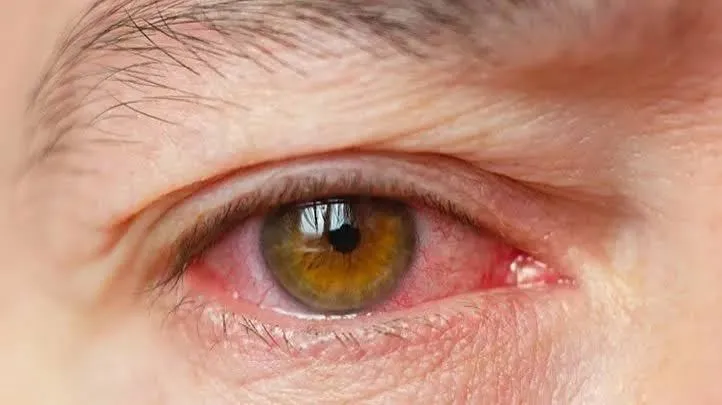
Dry eye: the essentials in 30 seconds
- A common paradox: a dry eye can water — reflex watering is a sign of dryness.
- Main causes: screens (we blink less), Meibomian gland dysfunction, age, certain treatments.
- Basis of treatment: preservative-free artificial tears + daily eyelid care.
- Resistant forms: assessment at the practice for targeted treatment.
What is dry eye?
With each blink, a thin tear film spreads over the eye to protect it, nourish it and keep vision clear. This film is not made of water alone: it combines an oily layer (which prevents evaporation), an aqueous layer (which hydrates) and a mucin layer (which makes the whole adhere to the surface).
We speak of dry eye when this balance is disrupted: either there are too few tears, or they evaporate too quickly. The surface of the eye, less protected, becomes irritated and inflamed — which sustains a vicious circle and makes the eyes uncomfortable.
Recognising the symptoms
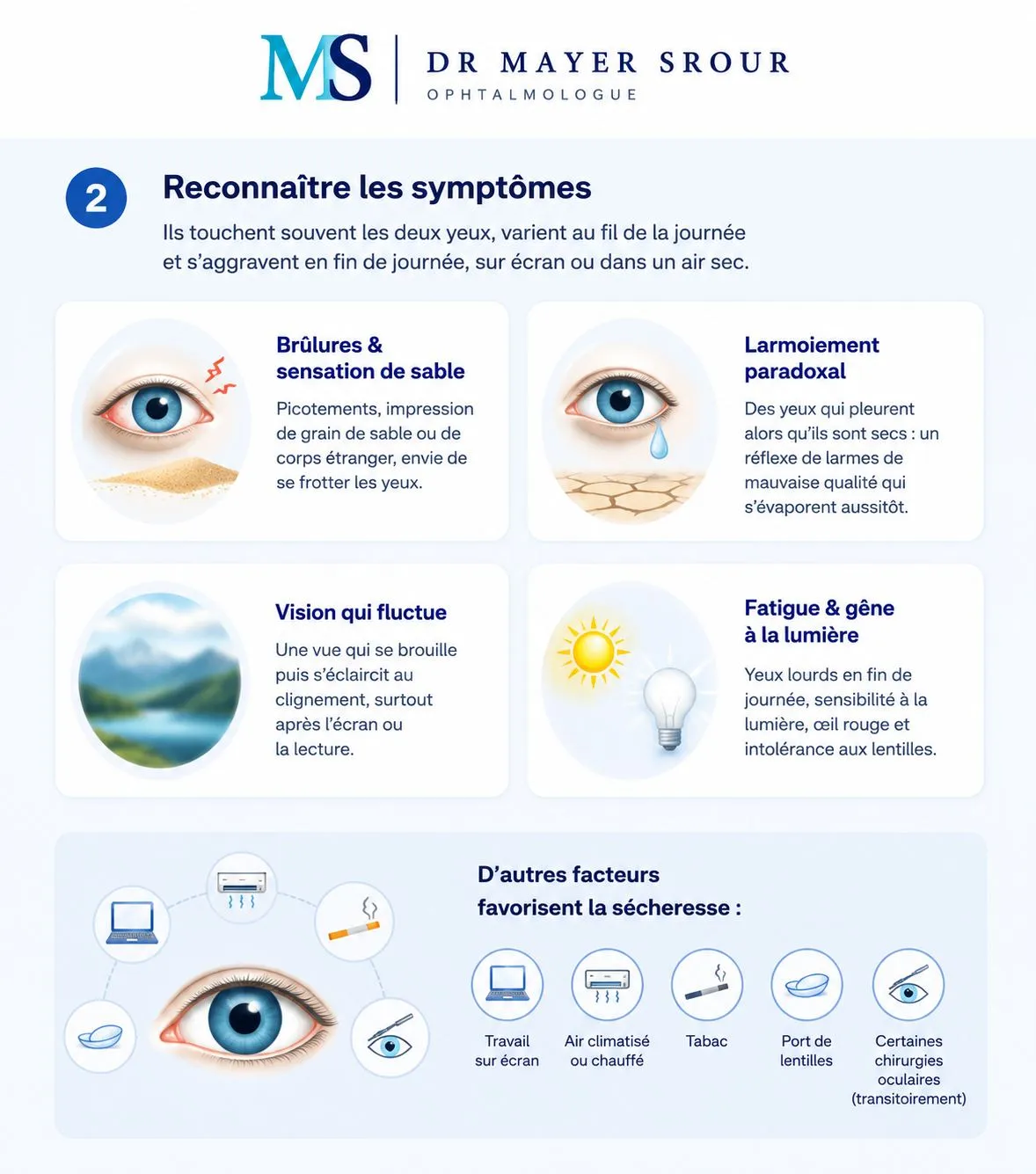
They often affect both eyes, vary over the course of the day and worsen at the end of the day, on screen or in dry air:
Two main mechanisms
Dry eye is not a single disease: understanding its mechanism means choosing the right treatment. In practice, mixed forms are the most frequent.
The assessment at the practice
In a single consultation, the examination determines the mechanism and the severity of the dry eye, so that a tailored treatment can be offered:
Treatments, step by step
We always start with the simplest measures, then add treatments if needed. The aim: to restore a stable tear film and calm inflammation of the surface.
Dry eye can almost always be relieved. It is a chronic condition that calls for consistency rather than a one-off cure: once properly identified and followed up, it allows a perfectly normal life.
Dry eye in Noisy-le-Grand
The Grand Paris Ophtalmologie practice provides assessment and management of dry eye on site, for patients from Noisy-le-Grand and eastern Paris (93, 94, 77): Bry-sur-Marne, Villiers-sur-Marne, Champs-sur-Marne, Chelles, Torcy and Marne-la-Vallée, as well as Le Perreux-sur-Marne, Nogent-sur-Marne, Fontenay-sous-Bois, Vincennes, Saint-Maur-des-Fossés, Créteil, Montreuil and Rosny-sous-Bois. Care is provided by Dr Yaïr Chetrit or Dr Mayer Srour, often in connection with associated blepharitis.
Dry eye: your questions
Answers from Dr Yaïr Chetrit and Dr Mayer Srour, ophthalmologists in Noisy-le-Grand.
Is dry eye serious for my eyesight?
Most often it affects comfort and quality of vision without threatening sight. Severe untreated forms can damage the cornea: follow-up makes it possible to spot and treat them in time.
Why do my eyes water when they are dry?
It is a paradoxical reflex: the irritated surface triggers poor-quality tears that evaporate straight away. Watering is a sign of dryness — treating the dryness makes it disappear.
Are screens responsible?
In front of a screen, we blink much less, which lets the tear film evaporate. The 20-20-20 rule and deliberate blinking clearly reduce symptoms.
Artificial tears with or without preservative?
Beyond 4 drops a day or with prolonged use, preservative-free tears (single-dose vials or special bottles) are preferred, as they are better tolerated by the surface of the eye.
What is Sjögren's syndrome?
An autoimmune disease that dries out the eyes and mouth. It is looked for with a blood test in cases of severe dry eye, in young patients, or when it is resistant to treatment; management is shared with a rheumatologist.
Can dry eye make it difficult to wear contact lenses?
Yes, this is common: lenses become uncomfortable at the end of the day. Treating the dryness and adapting the type of lens and the wearing schedule most often improves tolerance.
Related reading
Dry, burning or tired eyes?
An ocular surface assessment at the Noisy-le-Grand practice identifies the cause and brings lasting relief.
The Grand Paris Ophtalmologie practice in Noisy-le-Grand provides consultations, screening and surgery for patients from neighbouring towns: