

Intravitreal injections (IVT)
Intravitreal injections (IVT) in Noisy-le-Grand for patients from Seine-Saint-Denis (93), Val-de-Marne (94) and Seine-et-Marne (77): anti-VEGF (ranibizumab, aflibercept, faricimab, bevacizumab) and corticosteroid implants for wet AMD, diabetic macular oedema, retinal vein occlusions and neovessels in high myopia. Dr Mayer Srour, a retina specialist (more than 15 000 injections performed), carries out the follow-up OCT and the injection during the same visit, in the practice's injection room, without hospital admission; in an emergency (wet AMD, loss of vision), you are seen without an appointment and injected the same day. Patients referred by their ophthalmologist for injections are accepted.
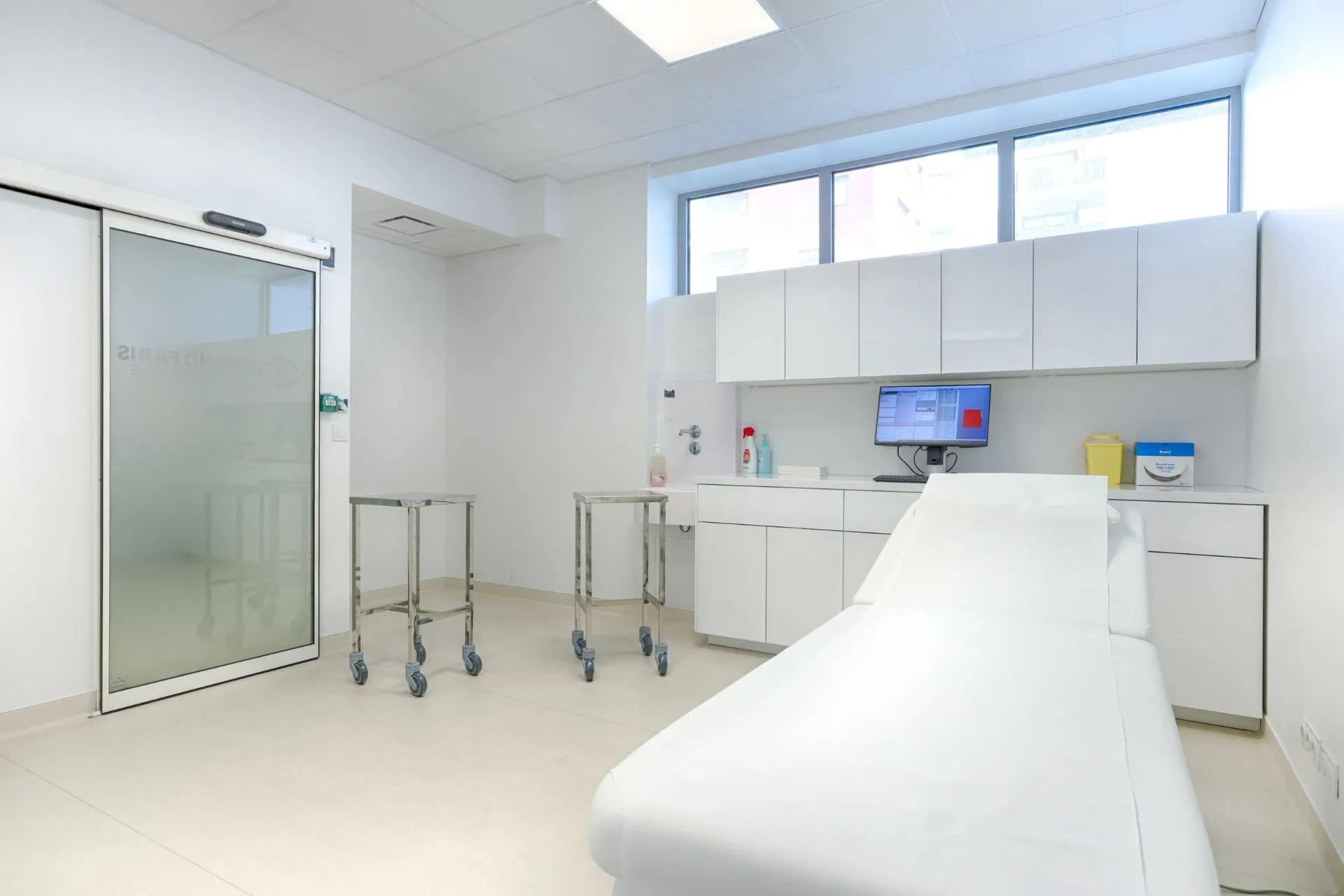
IVT delivers a medicine to the centre of the eye, as close as possible to the retina. It is the reference treatment for wet AMD, diabetic oedema and vein occlusions, carried out on site, in a dedicated room.
Intravitreal injections: the essentials in 30 seconds
- No delay: OCT and injection during the same visit, on site; in an emergency, seen without an appointment and injected the same day (93, 94, 77). Referred patients accepted.
- Quick procedure (a few seconds) under topical anaesthesia: the injection is barely felt.
- Reference treatment for wet AMD, diabetic macular oedema and vein occlusions.
- The schedule is counted in weeks: Q4 during the loading phase, then gradual spacing (Q8, Q12, Q16, even Q20) depending on response, adjusted by OCT at each check-up.
- Performed by Drs Srour and Chetrit; normal activities resume the same day in most cases.
What is an intravitreal injection?
An intravitreal injection (IVT) involves delivering a medicine directly into the vitreous, the clear gel that fills the eye. The active ingredient thus reaches the retina at high concentration, while limiting effects on the rest of the body.
The procedure lasts a few seconds, at the practice, under local anaesthesia with eye drops, using an extremely fine needle. It is not painful; at most you feel a brief pressure. It is now the reference treatment for several retinal diseases.
Which medicines are injected?
Two main families of medicines, chosen according to the disease and your response to treatment:
When is an IVT performed?
How is the injection carried out?
The whole visit takes about 15 minutes (including preparation); the injection itself lasts only a few seconds. You do not need to fast, and you keep taking your usual medication, including anticoagulants.
After the injection
What is normal: slight redness at the injection site (harmless, clears within a few days), a gritty, sand-in-the-eye sensation for a few hours (due to the Betadine), and sometimes small moving spots or slightly blurred vision for a short time.
For 48 hours: do not rub the eye, and avoid water (swimming pool, sea), make-up and dusty environments.
Warning signs — seek urgent care
In the days that follow, contact your ophthalmologist without delay if you have increasing eye pain, sudden loss of vision, increasing redness or unusual sensitivity to light.
These signs may point to an infection inside the eye (endophthalmitis), an exceptional complication but one that needs urgent treatment. 01 85 10 57 00
Long-term treatment
IVT is not a one-off procedure: treatment often starts with a loading phase (a few closely spaced injections), then a personalised schedule: injections are gradually spaced out as long as the disease remains stable, and brought closer together if it recurs (“treat and extend” protocol).
At each visit, a macular OCT and a vision measurement guide the decision. Regular follow-up is essential: interrupted treatment can lead to a relapse that is hard to recover from.
An intravitreal injection, filmed
Dr Mayer Srour shows in a few seconds what an IVT at the practice really looks like. It helps you arrive more at ease on the day of your injection.
Intravitreal injections in 3 minutes
In this video, Dr Mayer Srour answers the most common questions about injections for wet AMD.
Find all of Dr Srour’s videos on his YouTube channel: Subscribe to the channel
The official information sheet from the Société Française d'Ophtalmologie
Written by experts from the SFO (Société Française d'Ophtalmologie), it explains how the intravitreal injection is carried out, and its benefits and risks. To read before your treatment.
Your intravitreal injections in Noisy-le-Grand
The Grand Paris Ophtalmologie practice has a room dedicated to intravitreal injections, for patients from Noisy-le-Grand and eastern Paris (93, 94, 77): Bry-sur-Marne, Villiers-sur-Marne, Champs-sur-Marne, Chelles, Torcy and Marne-la-Vallée, as well as Le Perreux-sur-Marne, Nogent-sur-Marne, Fontenay-sous-Bois, Vincennes, Saint-Maur-des-Fossés, Créteil, Montreuil and Rosny-sous-Bois. Your injections are given on site, without hospital admission, by Dr Mayer Srour or Dr Yaïr Chetrit, with the follow-up OCT in the same place.
Intravitreal injections: your questions
Answers from Dr Mayer Srour and Dr Yaïr Chetrit, ophthalmologists in Noisy-le-Grand.
Does the injection hurt?
No: thanks to the anaesthetic eye drops, the injection is painless or almost painless, at most a brief pressure. Any discomfort afterwards (stinging) comes from the Betadine, not the injection.
Do I need to stop my anticoagulants?
No. There is no need to stop anticoagulants or antiplatelet drugs: the risk of bleeding is minimal and does not justify the risks of stopping them.
Do I need to fast?
No: IVT is performed under local anaesthesia with eye drops, never under general anaesthesia. You eat normally.
How soon can I have an injection?
The same day in an emergency (wet AMD with loss of vision, haemorrhage, oedema): you are seen without an appointment, and the OCT and injection are done straight away. For ongoing treatment, the follow-up OCT and injection take place during the same visit, on the date set by your protocol (in weeks: Q4, Q8, Q12, Q16…).
My ophthalmologist is referring me for injections: how does it work?
Book an appointment on Doctolib or on 01 85 10 57 00, stating that you are referred for IVT, and bring your latest tests (OCT, letter). Dr Mayer Srour carries out the follow-up OCT and the injection on site, then keeps your ophthalmologist informed by letter.
How many injections will I need?
Most often a loading phase of a few injections, then a personalised schedule (“treat and extend”), spaced as far apart as possible while the disease remains stable. The number depends on the disease and your response.
Can I drive afterwards?
It is not recommended straight afterwards: vision may be blurred for a few hours. Plan to be accompanied or to use public transport.
Is IVT reimbursed?
Yes: the injection and the anti-VEGF drugs are covered by the French national health insurance (Assurance Maladie). Your supplementary private insurance (mutuelle) generally covers any remaining out-of-pocket cost.
What are the side effects of an intravitreal injection?
The most common are mild and temporary: redness at the injection site (subconjunctival haemorrhage), a gritty sensation due to the Betadine, a few floaters or blurred vision for a few hours, and sometimes a temporary rise in eye pressure. The serious complication, endophthalmitis (infection), is exceptional: increasing pain, loss of vision or increasing redness in the days that follow require a same-day consultation.
Where can I have an intravitreal injection near Marne-la-Vallée?
At the Grand Paris Ophtalmologie practice, 67 rue de Malnoue in Noisy-le-Grand (93160), in a room dedicated to injections. The practice is five minutes from the A4 and the RER A, and sees patients from Seine-Saint-Denis, Val-de-Marne and Seine-et-Marne, including Marne-la-Vallée, Chelles, Bry-sur-Marne, Champs-sur-Marne, Torcy and Lagny-sur-Marne.
Can I have my injections at the practice rather than at the hospital?
Yes. The intravitreal injection is carried out during a consultation, in a dedicated room, without hospital admission or general anaesthesia. The follow-up OCT and the injection take place during the same visit, which avoids a second trip and shortens the delay between the check and the treatment.
I am followed at another centre: can I have my injections here?
Yes. Patients referred by a colleague or followed elsewhere are accepted, including mid-protocol. Bring your reports, your previous OCT scans and the name of the product used: the protocol is resumed without interruption, and a report is always sent to your ophthalmologist.
Related reading
Need to arrange injection follow-up?
Your injections are carried out at the Noisy-le-Grand practice, in a dedicated room, with the follow-up OCT on site.
The Grand Paris Ophtalmologie practice in Noisy-le-Grand provides consultations, screening and surgery for patients from neighbouring towns: