

Cataract surgery in Noisy-le-Grand
Cataract surgery for patients from Seine-Saint-Denis (93), Val-de-Marne (94) and Seine-et-Marne (77): the assessment (biometry, OCT) is carried out at the Noisy-le-Grand practice, the operation takes place as a day case at the Hôpital Privé de Marne-la-Vallée (Bry-sur-Marne), performed by Dr Mayer Srour or Dr Yaïr Chetrit, and follow-up resumes at the practice. You are operated on within 2 months of the assessment, and in under a month if the cataract is urgent. The operation lasts about fifteen minutes, under drop anaesthesia, and vision generally improves within a few days; the surgery is covered by the Assurance Maladie (French national health insurance), and a quote (devis) is provided before the operation if extra fees (dépassement d'honoraires) or a premium implant are planned (see fees and reimbursement).
A quick, safe and painless operation to regain clear vision. Performed as a day case by Dr Srour and Dr Chetrit, with a full assessment carried out at the Noisy-le-Grand practice.
Cataract surgery: the essentials in 30 seconds
- Timing: with Dr Mayer Srour, surgery within 2 months of the assessment (under a month if urgent). Assessment and follow-up in Noisy-le-Grand, surgery in Bry-sur-Marne, for the 93, 94 and 77 departments.
- The most commonly performed operation in the world: 15 to 20 minutes, as a day case, under local anaesthesia.
- The clouded lens is replaced by a tailor-made implant (biometry): monofocal, toric or multifocal.
- Visual recovery within a few days; one eye at a time, 1 to 2 weeks apart.
- Covered by the Assurance Maladie (French national health insurance); premium implants can reduce dependence on glasses.
Cataracts, made clear
The essentials to know before your operation, in 6 simple points.
What is a cataract?
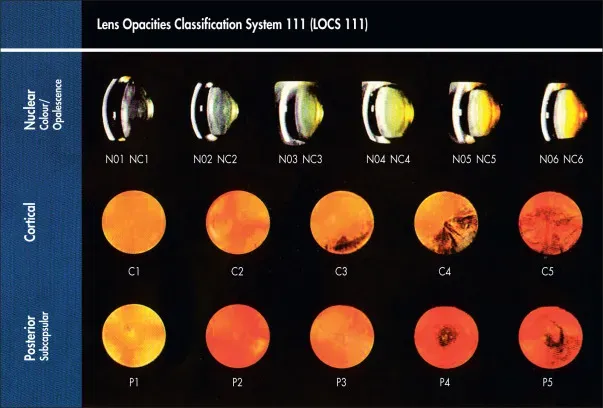
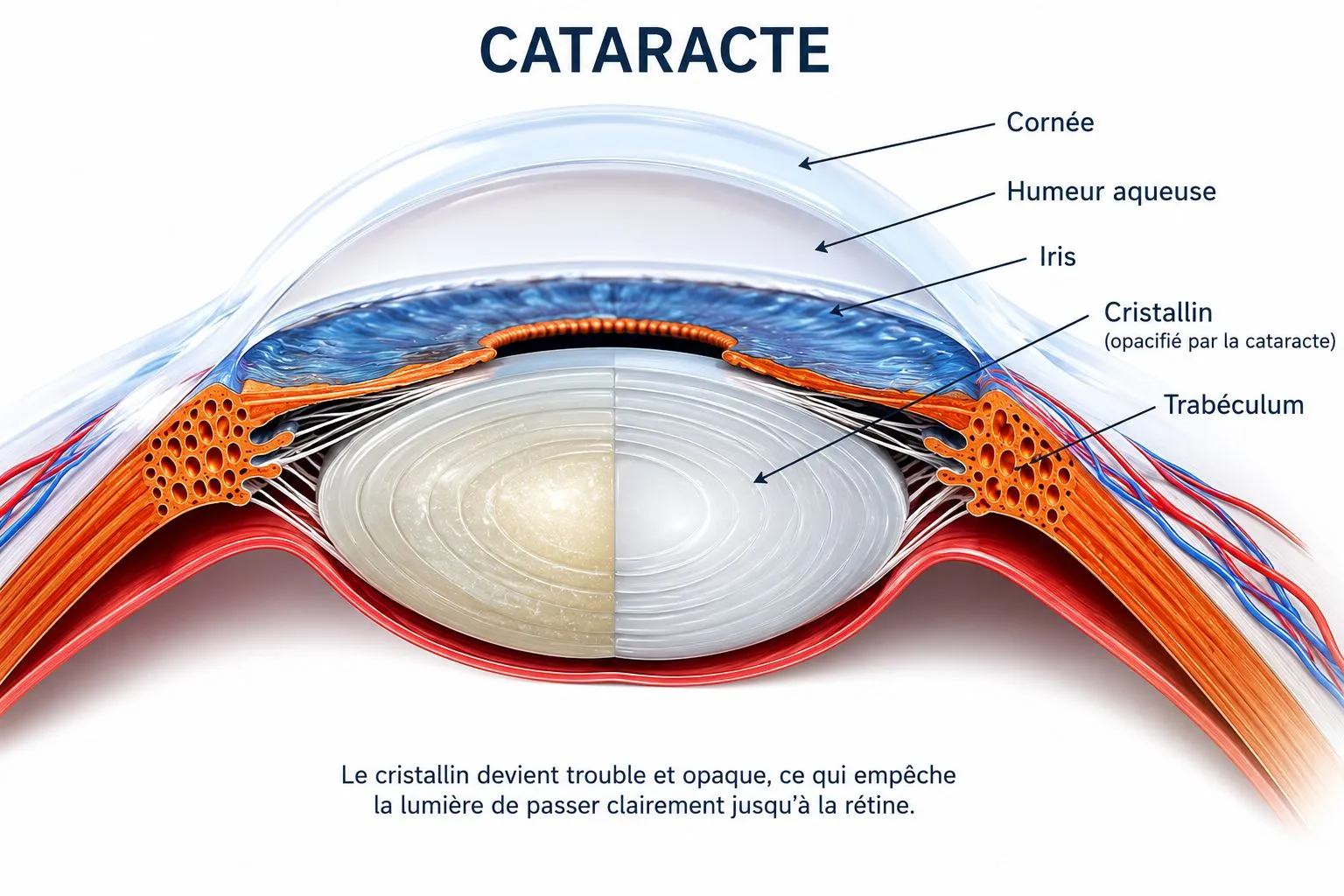
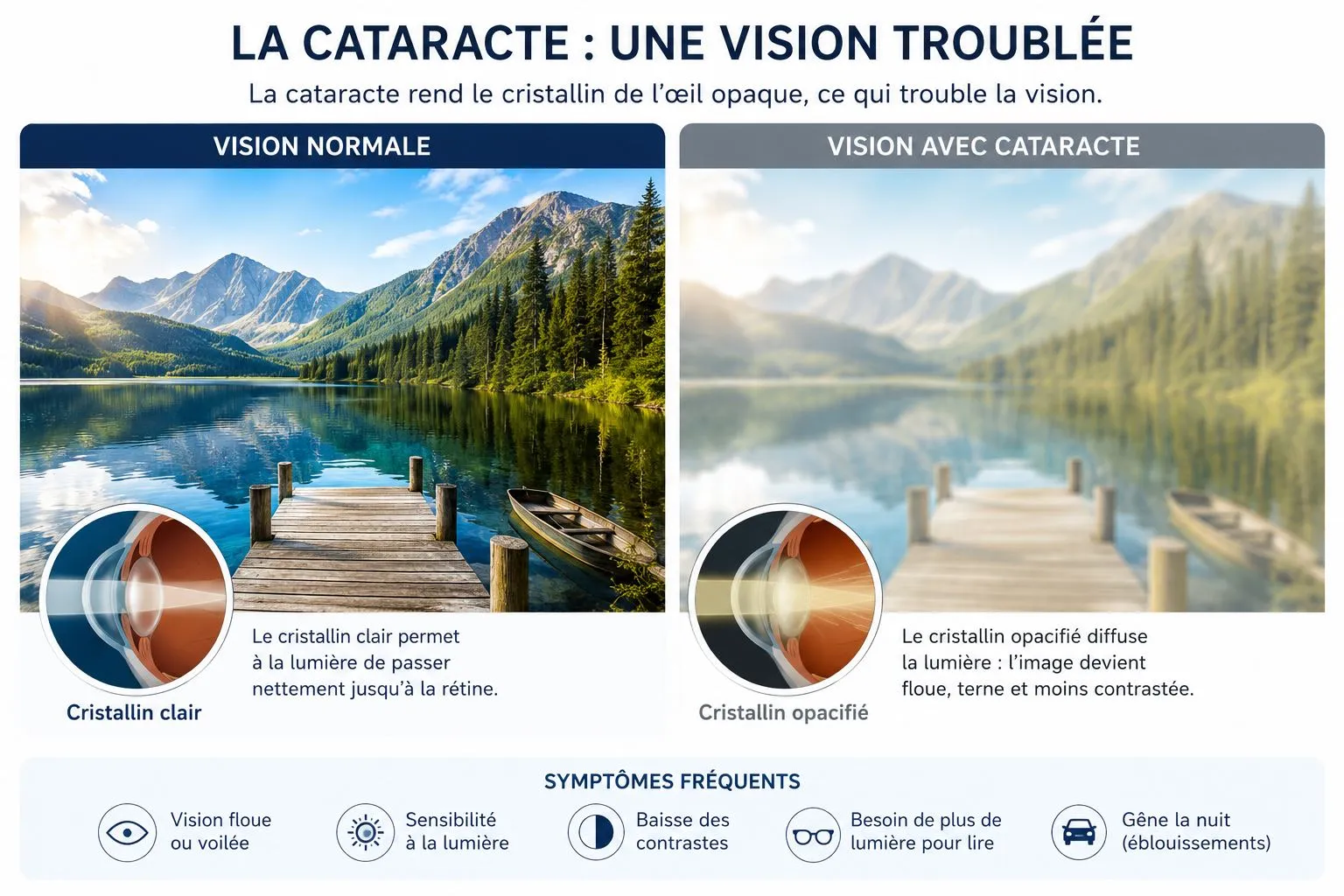
Behind the pupil lies the lens, the small natural lens of the eye that focuses images on the retina. With age, its proteins become disorganised and it gradually becomes opaque: less light gets through, and vision becomes hazy.
It is an extremely common phenomenon: cataract affects about 1 person in 5 after the age of 65 and the vast majority after 85. With nearly 800,000 operations a year in France, its surgery is the most commonly performed surgical procedure in the country — and one of the safest.
Good to know: it is not necessary to wait for the cataract to be “ripe”. Operating without waiting for an advanced stage makes the procedure simpler and recovery faster.
Warning signs
Who is surgery recommended for?
Cataract surgery is mainly indicated when the patient experiences a drop in vision or visual discomfort. Your ophthalmologist simply noting a cataract, in the absence of any symptoms, is never enough to justify surgery.
Double vision in a single eye or excessive glare may also contribute to the decision. In some cases, surgery may be indicated if the volume of the lens pushes the iris forward or causes a rise in eye pressure.
The pre-operative assessment
The diagnosis is clinical: reduced vision that is not improved by glasses, and clouding of the lens seen on biomicroscopy after dilation of the pupil. Fundus photographs and an OCT may be performed to rule out any other associated condition.
If surgery is decided on, additional tests are carried out on the practice's technical platform: biometry to calculate the power of the implant, and sometimes corneal topography in the case of astigmatism. A full pre-operative file is given to you with the clinic's contact details, the date of the operation and the steps to follow for the anaesthetic consultation.
How the operation goes
The operation is performed as day-case surgery, in a sterile surgical setting and under a microscope. The eye is numbed locally with simple drops — general anaesthesia is rarely necessary.
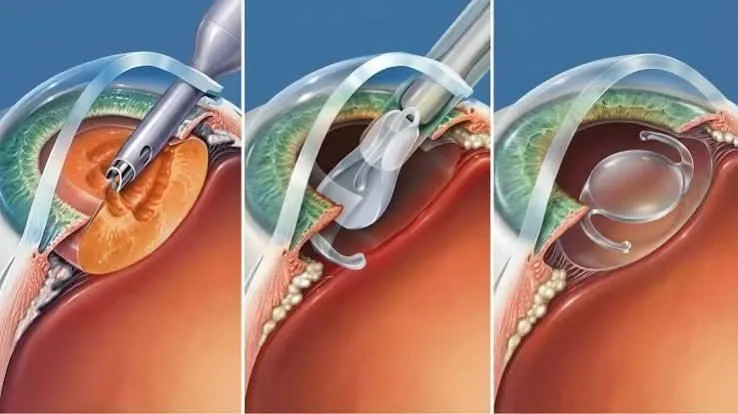
The clouded lens is removed by a probe passed through a small incision in the cornea, using a system of aspiration and ultrasound (phacoemulsification). It is replaced by a synthetic lens — the implant — placed behind the pupil. The incision only rarely needs a stitch. There are several types of implant (monofocal, EDOF, trifocal), chosen to suit you: find out which implant is right for you.
Cataract surgery filmed in the operating theatre: phacoemulsification and insertion of the implant, in a few minutes.
Find all of Dr Srour’s videos on his YouTube channel: Subscribe to the channel
Which implant for you?
The implant replaces your lens. There are several, depending on your eye and your lifestyle.
Sharp vision at one distance, most often distance. Glasses are still needed for reading. The safe choice, covered by the Assurance Maladie (French national health insurance).
Continuous vision from distance to intermediate range: driving, screens, cooking. Less dependence on glasses in everyday life.
The aim: to do without glasses, including for reading. Slight night-time halos are possible at first, while you adapt.
After the operation
Care is limited to putting in eye drops and wearing an eye shield as directed by your surgeon. In the vast majority of cases (99%), the operated eye is painless, and vision improves very quickly. A suitable pair of glasses can be prescribed after a few weeks.
Over the years, clouding of the posterior capsule (“secondary cataract”) may occur: its treatment with the YAG laser is painless, quick and done directly during a consultation at the practice. Temporary dry eye or the perception of floaters are also possible, and are generally well controlled with eye drops.
Instructions after cataract surgery
These instructions supplement the prescription and the report given to you on the day of the operation. The timings are indicative: your surgeon may adapt them to your case, and their instructions take precedence.
The stages after the operation
- The same day
- Go home accompanied: do not drive.
- Keep the dressing or shield on until the check-up the next day.
- Rest; you can eat and drink normally.
- Next day (D1)
- Check-up at the practice: removal of the shield, examination of the eye.
- Eye drops: start them at the time indicated on the prescription.
- 1st week
- Shield at night (and during naps) for 7 days.
- No water or soap in the eye; do not rub.
- Reading, screens, television: allowed.
- Around 1 month
- Check-up at the practice: end of eye drops, vision measured.
- Prescription of final glasses if needed.
- Return to all activities.
Putting in your eye drops properly
Treatment generally lasts about 1 month (exact duration on your prescription). Do not stop before the planned date, even if the eye is fine.
- Wash your hands before each instillation.
- Head tilted back, gently pull down the lower eyelid and look up.
- Put in one drop without the tip touching the eye or the lashes.
- Close the eye for 1 minute, pressing lightly on the inner corner.
- If you have several eye drops, wait 5 minutes between bottles.
- Clean the eyelids with saline solution on a sterile compress, from the nose outwards.
Resuming activities
| Activity | When? |
|---|---|
| Reading, screens, television | From the next dayno risk to the eye |
| Shower, hair washing | From the next dayhead tilted back, no water or soap in the eye |
| Office work | 2 to 3 dayslonger for physical work or a dusty environment |
| Driving | After the surgeon's approvalat the check-up, generally after a few days, if your vision reaches the legal minimum |
| Walking, calm activities | From the next day |
| Moderate sport (cycling, jogging, gym) | 1 week |
| Gardening, dusty housework | 2 weeksor with protective glasses |
| Eye make-up | 1 monththen use new products |
| Swimming pool, sea, sauna, steam room, jacuzzi | 1 monthrisk of infection |
| Contact, racket or ball sports | 1 month |
| Flying | Allowedremember to keep your eye drops in the cabin |
| New glasses | Around 1 monthat the check-up, once vision has stabilised; ready-made reading glasses can tide you over in the meantime |
Normal in the first few days
- Feeling of grit in the eye, watering, slight discomfort.
- Slightly blurred vision or glare at first.
- Red patch on the white of the eye (small, harmless bleed), which disappears in 1 to 2 weeks.
- Brighter or slightly bluer colours.
- A few small floaters, a bright reflection at the side of your field of vision: they generally fade.
- Slightly dry eye: artificial tears bring relief.
Seek advice without delay if…
- Pain increases instead of easing.
- Vision worsens after having improved.
- The eye becomes redder and redder, the eyelid swells, or discharge appears.
- You see flashes, a shower of black dots or a veil / curtain (possible retinal detachment, even months later).
- Headache with nausea or vomiting.
At the practice, Mon–Fri 8.30am–7pm: you are seen the same day, without an appointment. Emergencies are also seen between 1pm and 2pm, with no break. At night and at weekends: 24-hour eye emergencies at the Hôpital Fondation Rothschild (Paris 19th) or the Hôpital des Quinze-Vingts (Paris 12th).
In the years that follow, vision may fall again because of a secondary cataract (clouding of the capsule behind the implant): it is treated in a few minutes with the YAG laser, at the practice.
Instructions drawn up by Dr Mayer Srour based on the patient information sheet of the Société Française d'Ophtalmologie (SFO, 2026) and the post-operative protocols of the Hôpital Fondation Rothschild, Bordeaux University Hospital (CHU de Bordeaux), the Hôpital des Quinze-Vingts, the NHS / Moorfields Eye Hospital and the American Academy of Ophthalmology. Updated: September 2026.
Where does the operation take place?
The operation takes place at the Hôpital Privé de Marne-la-Vallée, in Bry-sur-Marne, a few minutes from the practice.
Having cataract surgery from Seine-et-Marne (77)
Many patients who have cataract surgery at the practice come from Seine-et-Marne: Champs-sur-Marne, Noisiel, Torcy, Lognes, Chelles, Vaires-sur-Marne, Pontault-Combault, Roissy-en-Brie and the whole Marne-la-Vallée area. The pathway is the same for everyone: consultation and biometry at the Noisy-le-Grand practice, day-case surgery at the Hôpital Privé de Marne-la-Vallée in Bry-sur-Marne, then check-ups at the practice. You do not have to go to Paris. The choice of implant (monofocal, toric, EDOF or trifocal) is made during the consultation, and a quote (devis) is provided before the operation if extra fees (dépassement d'honoraires) or a premium implant are planned.
Clear lens surgery
The cataract technique can also be offered before the lens becomes cloudy, for a purely refractive purpose: the still-transparent lens is replaced with a tailor-made implant to free you from glasses. This is known as clear lens exchange (or PRELEX).
It is mainly a solution after 50-55 years of age, when presbyopia sets in, or for high myopia and hypermetropia that are suitable for neither laser nor a phakic implant. A multifocal implant can then correct both distance and near vision.
Unlike cataract surgery, this elective surgery is not covered by the Assurance Maladie (French national health insurance). The indication is decided case by case, after a full assessment and detailed information on the benefits and risks.
Cataract surgery, filmed
Dr Mayer Srour shows how a cataract operation actually goes: a quick, painless and perfectly controlled procedure. A way to better understand the procedure before your operation.
Watch the video on Instagram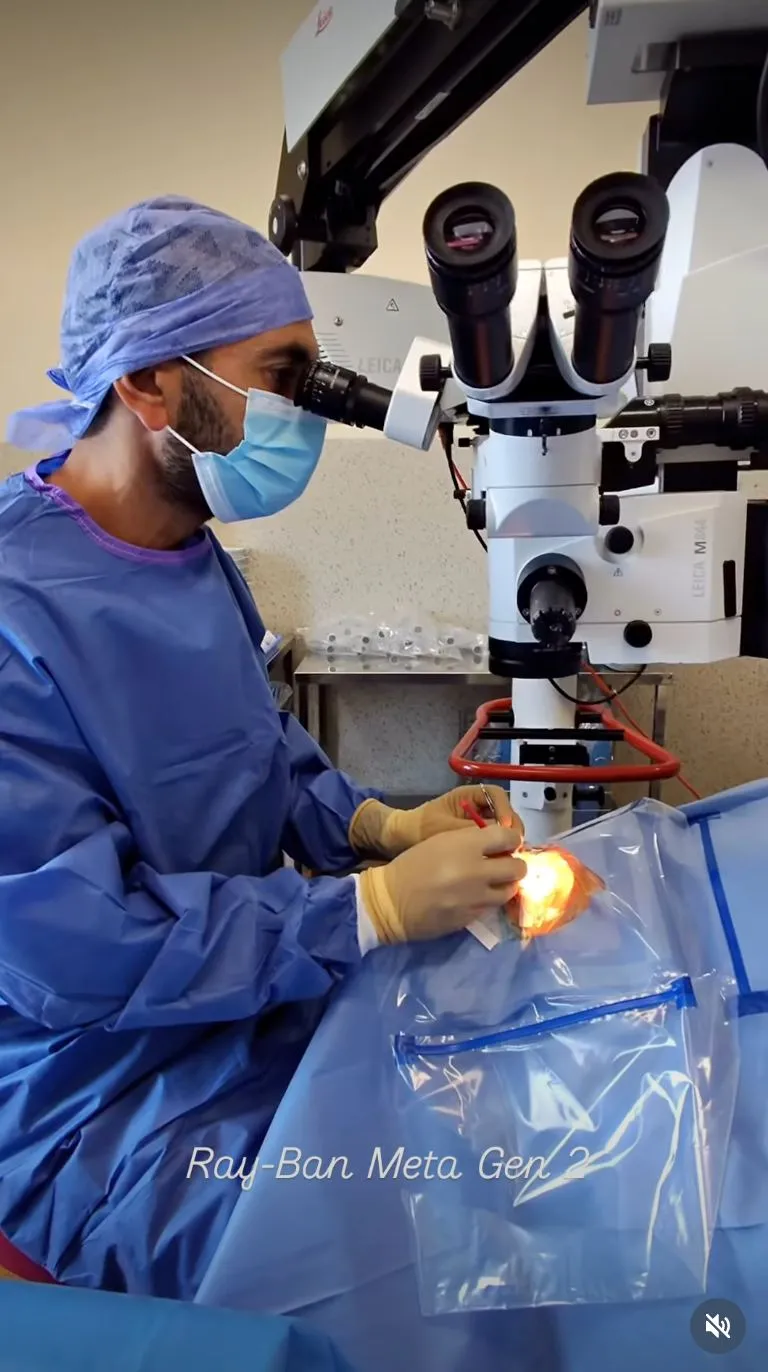
Official factsheets from the Société Française d'Ophtalmologie
Written by SFO experts, they describe how each procedure is carried out, and its benefits and risks. Please read them before your consultation.
Cataract surgery in Noisy-le-Grand and eastern Paris
The Grand Paris Ophtalmologie practice welcomes patients from Noisy-le-Grand and neighbouring towns in Seine-Saint-Denis (93), Val-de-Marne (94) and Seine-et-Marne (77): Bry-sur-Marne, Villiers-sur-Marne, Champs-sur-Marne, Neuilly-sur-Marne, Gournay-sur-Marne, Noisiel, Torcy, Chelles, Gagny and the whole Marne-la-Vallée area, as well as Le Perreux-sur-Marne, Nogent-sur-Marne, Fontenay-sous-Bois, Vincennes, Saint-Maur-des-Fossés, Créteil and Montreuil.
Dr Mayer Srour and Dr Yaïr Chetrit oversee the whole pathway: screening and assessment on the practice's technical platform, surgery at the Hôpital Privé de Marne-la-Vallée, then post-operative follow-up at the practice. Dr Srour has performed more than 6 400 cataract operations and is among the 100 best ophthalmologists in France in the 2023 Le Point ranking; with him, surgery is scheduled within 2 months of the assessment, and in under a month if urgent.
Cataract surgery: your questions
Answers from Dr Mayer Srour and Dr Yaïr Chetrit, ophthalmologists in Noisy-le-Grand.
How long does cataract surgery take?
The operation itself lasts only a few minutes per eye (≈ 5 minutes). With preparation and monitoring, allow half a day at the clinic: the operation is a day case and you go home the same day.
Is the operation painful?
No. The eye is numbed with simple anaesthetic drops and, in 99% of cases, the operated eye remains painless. A feeling of grit or passing stinging is possible in the first few days.
Is cataract surgery reimbursed?
Yes, surgery with a monofocal implant is covered by the Assurance Maladie (French national health insurance). Extra fees (dépassements d'honoraires) or premium implants (multifocal, toric) may remain payable depending on your mutuelle (supplementary health insurance); a quote (devis) is provided before the operation.
At what age should you have the operation?
There is no set age: the indication is based on the visual discomfort you experience, not on age. Cataract most often occurs after 65, but can appear earlier, particularly with diabetes, high myopia or corticosteroid treatment.
Does the implant last a lifetime? Can the cataract come back?
Yes: the implant is made of a biocompatible material designed to last a lifetime, with no wear or maintenance. And no, the cataract cannot come back once the lens has been replaced — only the capsule that supports the implant can become cloudy over time (“secondary cataract”), which is corrected in a few minutes with the YAG laser during a consultation.
Is it a risky operation?
It is one of the safest operations in modern medicine, with a success rate above 99%. Serious complications are exceptional and close follow-up (D+1 then D+30) allows everything to be monitored. Seek urgent advice in case of intense pain, sudden loss of vision, marked redness or flashes of light — the practice sees emergencies on the same day.
How soon can cataract surgery be done?
With Dr Mayer Srour, surgery takes place within 2 months of the assessment at the practice, and in under a month when the cataract is urgent (significant loss of vision, difficulty driving or working). The assessment and biometry are done in Noisy-le-Grand, the operation at the Hôpital Privé de Marne-la-Vallée (Bry-sur-Marne), and the next-day and one-month check-ups at the practice.
Are both eyes operated on at the same time?
In general, the two eyes are operated on a few days or weeks apart, to make sure the first eye recovers safely before operating on the second.
When can I drive again?
Driving is not recommended for a short period defined by your surgeon, while vision stabilises — often a few days. Vision improves very quickly after the operation.
What is secondary cataract?
In the years following the operation, the capsule that supports the implant may become cloudy and cause vision to worsen again. Treatment is simple: opening the capsule with the YAG laser, painless and quick, carried out directly during a consultation at the practice.
Which implant should you choose: monofocal, EDOF or trifocal?
The monofocal gives sharp vision at one distance (often distance) and is covered by the Assurance Maladie (French national health insurance). The EDOF (extended depth of focus) covers distance and intermediate: driving, screens, cooking. The trifocal aims for complete independence from glasses, including for reading. The choice is made together during the consultation, according to your eye, your correction and your lifestyle.
Where can I have cataract surgery near Noisy-le-Grand?
The pre-operative assessment and follow-up take place at the Grand Paris Ophtalmologie practice, 67 rue de Malnoue in Noisy-le-Grand (93160). The operation takes place at the Hôpital Privé de Marne-la-Vallée in Bry-sur-Marne, a few minutes from the practice.
What precautions should I take after cataract surgery?
Wear the shield at night for 7 days, use your eye drops for about 1 month as prescribed, do not rub the eye and avoid getting water in the eye during the first week. Reading and screens are allowed from the next day, moderate sport after 1 week, and swimming pools, saunas and eye make-up after 1 month. Increasing pain, a drop in vision or growing redness mean you must be seen the same day. See all the instructions.
I live in Seine-et-Marne: where can I have cataract surgery?
At the Hôpital Privé de Marne-la-Vallée (Bry-sur-Marne), a few minutes from the Noisy-le-Grand practice, as a day case. The pre-operative assessment and follow-up take place at the practice. Your pathway from the 77.
How many appointments are needed for cataract surgery?
Generally one consultation with biometry, the operation, then a check-up the next day or in the following days and a last one after about one month, for each eye.
Who performs the cataract operation?
Dr Mayer Srour, an ophthalmic surgeon who trained for 8 years at the CHI de Créteil, has performed more than 6 400 cataract operations, including complex cases (irregular corneas, white cataracts); he is among the 100 best ophthalmologists in France in the 2023 Le Point ranking. Dr Yaïr Chetrit, his partner at the practice, also performs cataract surgery.
How long is the wait for cataract surgery in Île-de-France?
Waiting times vary greatly from one establishment to another and can exceed six months in some centres in the Paris region. With Dr Mayer Srour, surgery is scheduled within two months of the assessment, and in under a month when the cataract is urgent (rapid loss of vision, very advanced cataract, only one functioning eye).
Do I need a referral from my ophthalmologist to have cataract surgery?
No. You can book directly at the Noisy-le-Grand practice for a cataract assessment, with or without a letter from a colleague. If you are already being followed elsewhere, bring your reports and recent tests: they avoid repeating what has already been done.
On video
A 50-year-old patient with total blindness: time-lapse extracts of the operation in the theatre (staining of the capsule, removal of the lens, insertion of the implant).
The team shows its support for women affected by breast cancer and their loved ones: look after yourself, and talk to a healthcare professional about screening.
Related reading
Visual discomfort? Let's talk.
Dr Srour and Dr Chetrit carry out the full assessment at the practice and support you at every step.
The Grand Paris Ophtalmologie practice in Noisy-le-Grand provides consultations, screening and surgery for patients from neighbouring towns: