

OCT angiography: vessels without dye
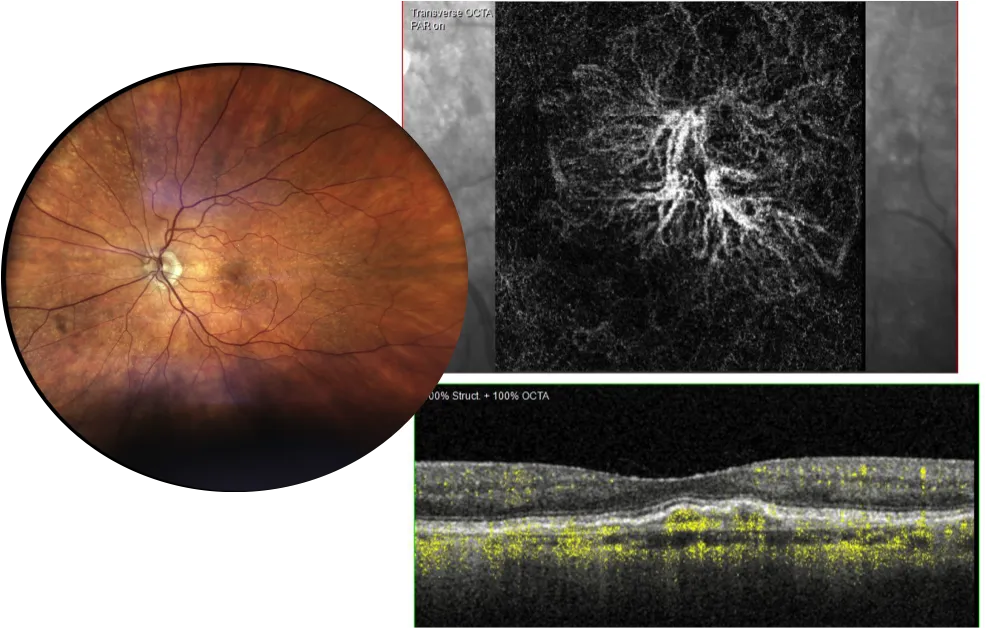
OCT angiography maps the vessels of your retina without any dye injection. A major asset for AMD, diabetic retinopathy and vascular occlusions.
OCT angiography: the essentials in 30 seconds
- A complete vascular map of the macula, with no injection, no dye and no contact.
- A few seconds per eye; can be repeated at every consultation to monitor a treatment.
- Complements or replaces conventional angiography in many situations (AMD, diabetes).
- Available at the practice on a latest-generation Spectralis OCT.
What is OCT angiography?
OCT angiography (or OCT-A) is an evolution of OCT that maps the vessels of the retina and choroid — without any injection. The device detects the movement of red blood cells in the vessels and reconstructs the whole vascular network, layer by layer.
The result: a precise map of the circulation, obtained in a few seconds, with no needle, no dye and therefore no risk of allergy.
OCT-A or fluorescein angiography?
The two tests are complementary — they are not in competition:
When is it useful?
What happens during the examination?
It takes place exactly like a standard OCT: seated, chin on the rest, you look at a light target for a few seconds per eye while the device scans the retina. No injection, no contact, no pain — the examination lasts a few minutes, and dilation is not always necessary. The results are interpreted immediately by your ophthalmologist.
Dr Srour has contributed to research on OCT angiography
Trained at the CHI de Créteil, a reference centre for macular imaging, Dr Mayer Srour has taken part in several international studies on OCT angiography, alongside Prof Querques:
OCT angiography in Noisy-le-Grand
The Grand Paris Ophtalmologie practice has an OCT with an angiography module, for patients from Noisy-le-Grand and eastern Paris (93, 94, 77): Bry-sur-Marne, Villiers-sur-Marne, Champs-sur-Marne, Chelles, Torcy and Marne-la-Vallée, as well as Le Perreux-sur-Marne, Nogent-sur-Marne, Fontenay-sous-Bois, Vincennes, Saint-Maur-des-Fossés, Créteil, Montreuil and Rosny-sous-Bois. The examination is performed and interpreted on site by Dr Yaïr Chetrit or Dr Mayer Srour.
OCT angiography: your questions
Answers from Dr Yaïr Chetrit and Dr Mayer Srour, ophthalmologists in Noisy-le-Grand.
Is it like an angiogram “with a needle”?
No, precisely not: OCT-A maps the vessels without any injection, by detecting blood flow. No dye, so no risk of allergy.
Is it painful?
Not at all — no contact with the eye, like a standard OCT. You simply look at a target for a few seconds.
Does it replace fluorescein angiography?
Not always: fluorescein angiography remains essential for seeing leakage in real time. The two are complementary.
In which diseases is it useful?
Mainly AMD (new vessels), diabetic retinopathy, venous and arterial occlusions, and study of the optic nerve.
Related reading
Have you been prescribed an OCT angiography?
The examination is carried out at the Noisy-le-Grand practice and interpreted immediately.
The Grand Paris Ophtalmologie practice in Noisy-le-Grand provides consultations, screening and surgery for patients from neighbouring towns: