

The Humphrey visual field test (perimetry)
The visual field test maps the sensitivity of your vision point by point, at the centre and in the periphery. It is the reference test for screening for and monitoring glaucoma.
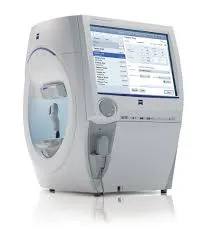
Visual field test: the essentials in 30 seconds
- Can you drive after a visual field test? Yes: there is no dilation, and your vision is normal straight away.
- Duration: 5 to 10 minutes per eye, painless.
- Equipment: our Humphrey HFA3 perimeter (Zeiss) (the international reference), at the practice.
- Driving licence or MDPH application: it is the binocular visual field (Esterman test) that is requested.
What is a visual field test (Humphrey perimetry)?
The visual field is the whole area of space that each eye perceives — what you are looking at, but also everything around it. Automated perimetry measures it point by point: lights of varying intensity are presented in a bowl, and the device records which ones you perceive in order to draw up a sensitivity map of your retina and optic nerve.
Its great value: detecting areas of reduced sensitivity that you do not notice in everyday life — the brain fills in the gaps. This is why glaucoma can progress for years without any perceived symptoms.
When is it indicated?
The binocular visual field: driving & MDPH application
Alongside the eye-by-eye test, the practice also performs the binocular visual field test (Esterman test, sometimes spelt Estermann): with both eyes open, it measures the field of vision that you can actually use in everyday life. This is the test requested for administrative procedures:
What happens during the examination?
Reading the results of a Humphrey visual field test
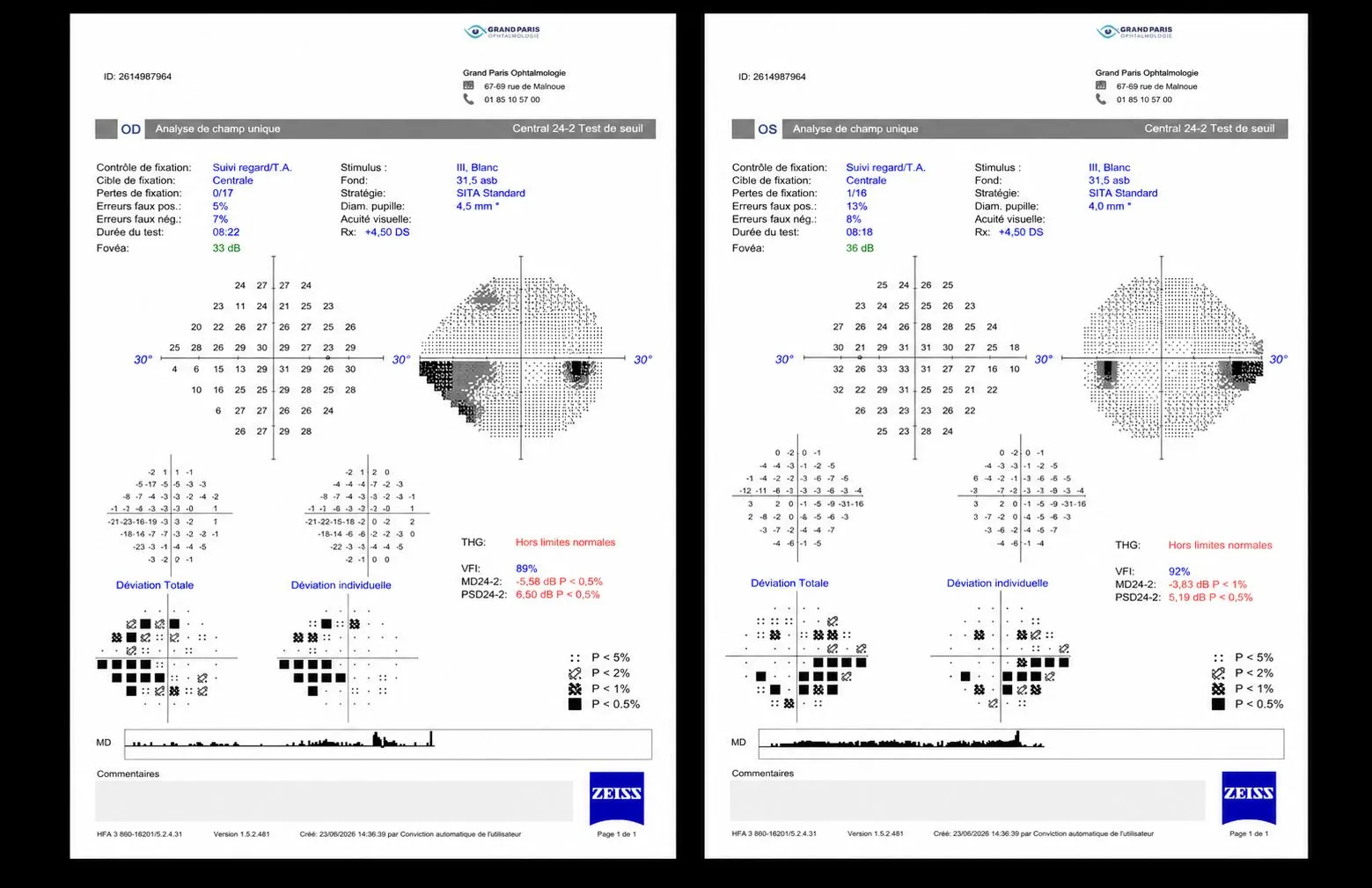
The report of a Humphrey visual field test first includes reliability indices: fixation losses, false positives and false negatives. If these are too high, the test needs to be repeated. Next come the sensitivity and deviation maps, which locate the areas that are less well perceived, followed by global indices: the MD (mean deviation), the PSD (pattern standard deviation, a measure of field irregularity) and the VFI (visual field index, the percentage of visual field preserved). In glaucoma, what matters most is how these indices change from one test to the next, which is why it is worth always repeating the test on the same device.
Visual field testing in Noisy-le-Grand
The Grand Paris Ophtalmologie practice is equipped with a Humphrey automated perimeter, the international reference, for patients from Noisy-le-Grand and eastern Paris (93, 94, 77): Bry-sur-Marne, Villiers-sur-Marne, Champs-sur-Marne, Chelles, Torcy and Marne-la-Vallée, as well as Le Perreux-sur-Marne, Nogent-sur-Marne, Fontenay-sous-Bois, Vincennes, Saint-Maur-des-Fossés, Créteil, Montreuil and Rosny-sous-Bois. The test is performed on site and interpreted by Dr Yaïr Chetrit or Dr Mayer Srour, in the same consultation as the optic nerve OCT if necessary.
The visual field test: your questions
Answers from Dr Yaïr Chetrit and Dr Mayer Srour, ophthalmologists in Noisy-le-Grand.
Is the visual field test painful?
No — no contact with the eye, no drops, no dilation. It simply requires concentration for 5 to 10 minutes per eye.
Is it serious if I do not see every point during the visual field test?
No, it is intentional: the device presents increasingly faint points, up to the limit of your perception, in order to measure your sensitivity threshold. Nobody sees every point.
Can you drive after a visual field test?
Yes — the test requires no dilation: your vision is normal immediately afterwards.
Where can I have a visual field test near Noisy-le-Grand?
At the Grand Paris Ophtalmologie practice, 67 rue de Malnoue in Noisy-le-Grand (93160), equipped with a Humphrey automated perimeter, the international reference. The test is interpreted on site by Dr Chetrit and Dr Srour. Telephone: 01 85 10 57 00.
Why repeat the visual field test regularly when you have glaucoma?
Because glaucoma progresses silently: it is the comparison of successive printouts that measures progression and allows treatment to be adapted in time.
Visual field or OCT: what is the difference?
The two are complementary: OCT measures structure (the thickness of the optic nerve fibres), while the visual field measures function (what you actually perceive). Glaucoma monitoring relies on both, carried out at the practice.
What is the difference between the Humphrey visual field and the Goldmann visual field?
The Humphrey is a static automated perimetry: the device measures the perception threshold point by point, and it is the reference test for glaucoma. The Goldmann is a manual kinetic perimetry, which outlines the extent of the field by moving a target; it is mainly used in neuro-ophthalmology. For a driving licence or an MDPH application, see the section on the binocular visual field.
Is a visual field test needed for a driving licence or an MDPH application?
Yes: it is the binocular visual field (Esterman test, both eyes open) that is requested for the opinion on fitness to drive and for MDPH applications. It is performed at the practice, and the printout and report are given to you.
What if I am tired or I blink during the test?
You can blink normally and take a break if needed — simply let us know. The device continuously monitors the reliability of the test (fixation, false positives) and the test can be repeated if necessary.
Related reading
Have you been prescribed a visual field test?
The test is carried out at the Noisy-le-Grand practice and interpreted in the same consultation.
The Grand Paris Ophtalmologie practice in Noisy-le-Grand provides consultations, screening and surgery for patients from neighbouring towns: