AMD: how to recognise the first signs and get screened
A straight line that suddenly looks wavy, a blurred spot that interferes with reading: these signs, often subtle at first, can herald age-related macular degeneration (AMD). It is the leading cause of visual impairment after 55 in Western countries, and it progresses for a long time without the patient realising, because usually only one eye is affected at the start — the other compensates.

The macula is a small 2 mm area at the centre of the retina, which on its own handles nearly 90% of useful visual information: it lets you read, recognise a face or drive. With age, this area can gradually deteriorate: this is AMD, which most often begins after 55. Contrary to popular belief, it never causes total blindness — peripheral vision remains intact — but it can have a major impact on independence in daily life.
Warning signs
Four typical symptoms
Blurred or less sharp vision in the centre of the visual field, straight lines that look distorted or wavy (for example a door frame or tiling), a dark spot that interferes with fixation, and colours that seem less vivid, with a general loss of contrast. These signs often develop in only one eye, which makes them easy to miss: the brain compensates with the other eye, and the problem goes unnoticed for months.

The Amsler grid test, to do at home
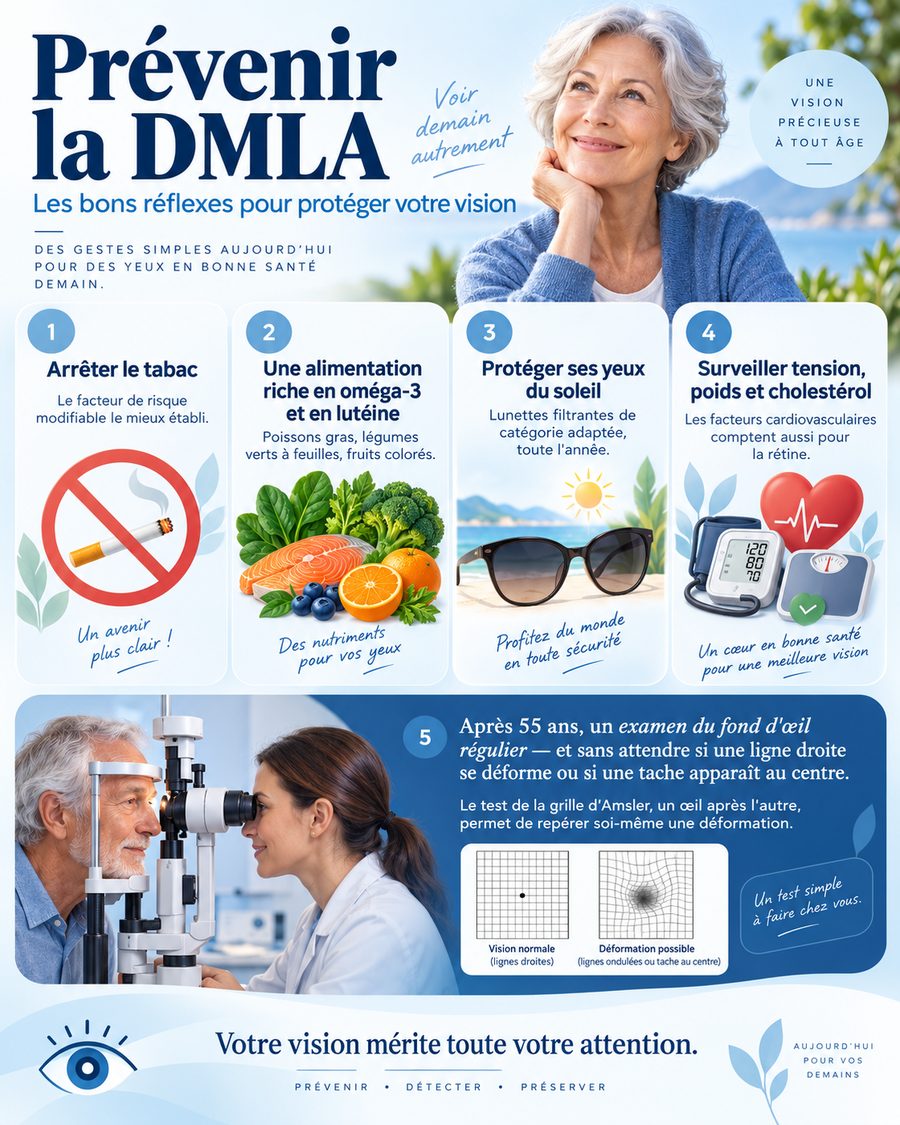
A simple test lets you monitor yourself between consultations: the Amsler grid, a square grid with a fixation point at the centre. Covering one eye and then the other, at your usual reading distance, you check that the lines stay straight and that the central point is sharp. Any line that looks wavy, or any blurred or dark area, should lead you to be seen promptly, without waiting for your next scheduled appointment.
Two forms, two different courses
The dry (atrophic) form, the more common, progresses slowly through gradual atrophy of the macula; it is monitored regularly to detect any change to the wet form. The wet (exudative) form, rarer but fast-moving, corresponds to the appearance of abnormal vessels under the macula, causing a drop in vision that can be sudden. It is treated with injections into the eye, the rhythm of which is now individualised for each patient according to their pattern of progression.
Prevention and screening: what is in your power
Age and heredity cannot be changed, but several risk factors can: stopping smoking, the main modifiable factor; favouring a diet rich in omega-3 and lutein (oily fish, leafy green vegetables, colourful fruit); protecting your eyes from the sun all year round with suitable filtering glasses; and monitoring blood pressure, weight and cholesterol, cardiovascular factors that also matter for retinal health. After 55, a regular fundus examination remains the best way to detect AMD before troublesome symptoms appear.