
Do the pupils need to be dilated at every visit?
No, dilation is not routine. It depends on your reason for consulting and the examinations to be carried out. Here is when it is useful, how it works and what it means for your day.
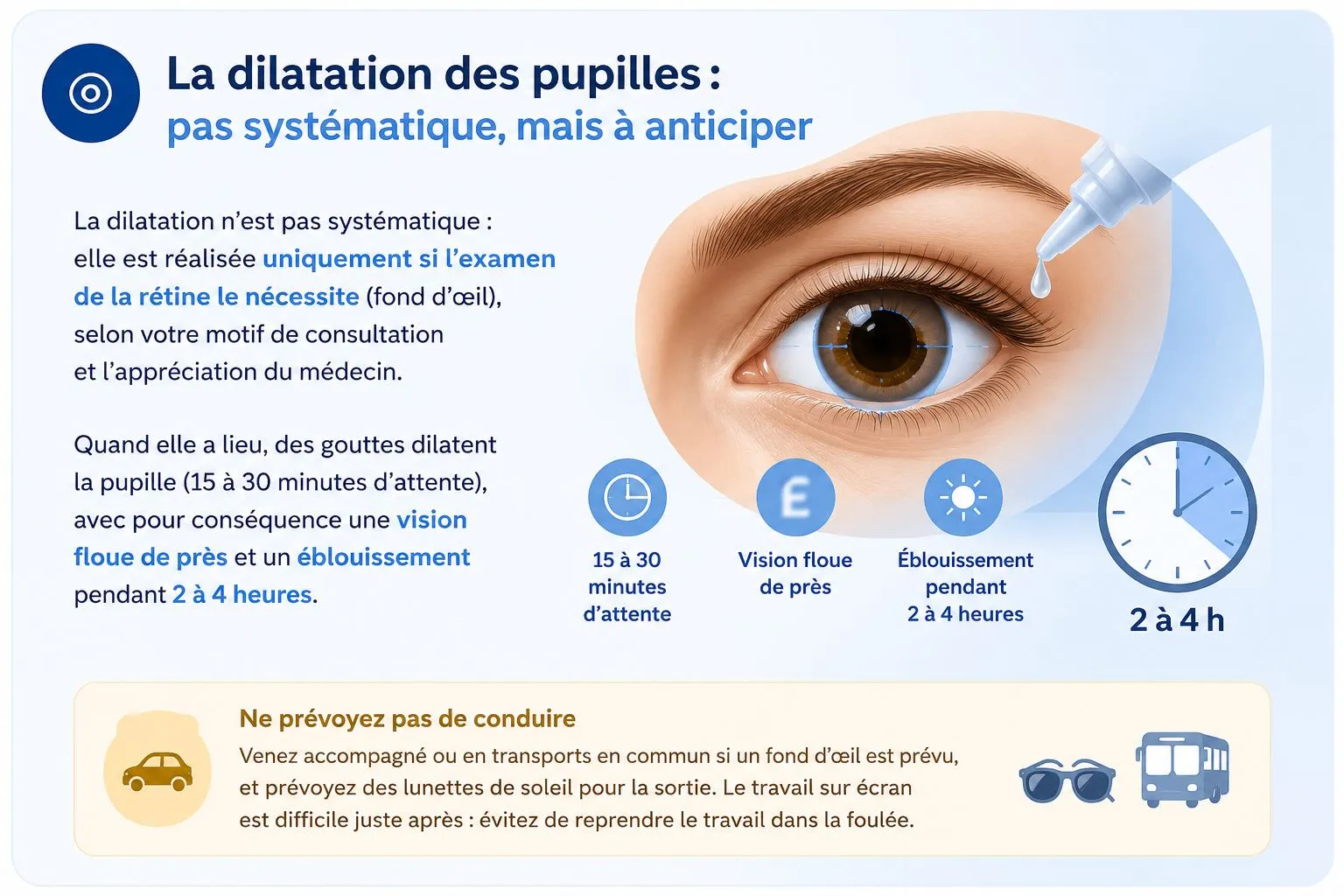
Many patients arrive thinking they will leave with “blurred, dazzled eyes”. That is far from always the case: the pupil is dilated (mydriasis) only if the examination requires it. At the practice, some check-ups are now done without dilation, thanks to modern imaging.
What is dilation for?
Eye drops dilate the pupil for a few hours to enlarge the “window” through which the ophthalmologist views the back of the eye: the peripheral retina, the macula and the optic nerve. It is essential for seeing the whole of the peripheral retina properly, which instruments do not always capture fully.
When is it really necessary?
- a complete retinal assessment: follow-up of diabetes, of high myopia, or an AMD assessment;
- warning signs: flashes, floaters, a veil — looking for a tear or detachment;
- a pre-operative assessment (notably before cataract surgery);
- eye examination in children, where dilation also allows the prescription to be measured accurately.
When can it be avoided?
For many targeted check-ups — OCT of the macula or optic nerve, OCT angiography, visual field testing or wide-field retinal photography — dilation is not always necessary. This is one of the advantages of a full range of equipment: adapting the examination to your situation rather than dilating by default.
How does it work and how long does it last?
One drop is instilled in each eye; the effect begins within 20 to 30 minutes and generally wears off within 3 to 6 hours. During this time, near vision is blurred and glare is more pronounced. The drops may sting for a second or two, but are harmless. Once the effect has passed, your vision returns exactly as before.
At the practice
At your first consultation, the ophthalmologist decides case by case, depending on your reason for visiting and your history. All examinations are carried out on site in Noisy-le-Grand, with or without dilation depending on what is genuinely useful for your eye.