
Night driving: seeing the road clearly as the days get shorter
Halos around headlights, glare, road signs that look less sharp: as the days shorten, night driving often reveals a visual problem. Common causes, good habits and when to see a specialist.
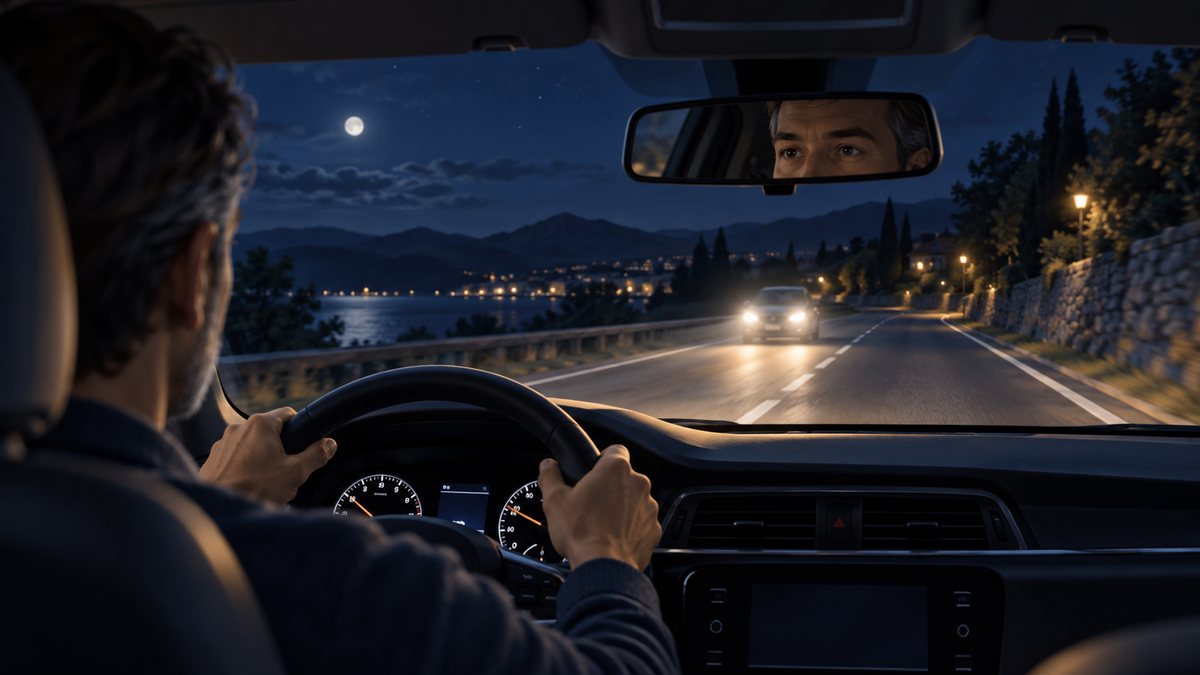
Seeing a little less well at night is normal, but new glare, halos or blurred vision at the wheel should prompt a vision check. The most common causes are an unsuitable correction, cataract and dry eye. To drive, the visual acuity of both eyes together must be at least 5/10.
In autumn, a good share of the journey to and from work takes place at dusk or in the dark. The clocks going back, in the night of 24 to 25 October 2026, accentuates this shift even further: in the evening, many drivers in eastern Paris now head home in the dark. This is often when people notice headlights that dazzle more, halos around lights or road signs that look less sharp. These signs are not always harmless.
Why is it harder to see at night?
Even with perfectly healthy eyes, night vision is less efficient than daytime vision. In the dark, the pupil dilates to let in more light. Light rays then pass through the periphery of the lens and cornea, where small optical imperfections are more pronounced. Contrast falls, the perception of relief and distance becomes less precise, and the eye takes longer to recover after glare.
In some people, this effect is amplified by a visual problem or an eye condition that goes unnoticed in full daylight.
Common causes of difficulty driving at night
An uncorrected visual defect
A slight degree of uncorrected myopia or astigmatism, or a correction that is no longer suitable, is felt mostly at night. This is sometimes called “night myopia”: the dilated pupil makes blur more noticeable. Glasses that are several years old deserve a check.
Cataract
It is one of the leading causes of night-time glare after the age of 60. The lens gradually becomes cloudy and scatters the light from headlights, creating halos and a veil. The drop in vision is often subtle by day, while night driving becomes tiring. When this difficulty affects daily life, cataract surgery can be discussed with your ophthalmologist.
Dry eye
Heating in the car, ventilation directed at the face and concentration (which reduces blinking) dry out the surface of the eye. An irregular tear film blurs vision and increases light scatter. Vision that fluctuates and improves when you blink suggests dry eye.
Diseases of the retina and optic nerve
Some conditions, such as AMD, diabetic retinopathy or advanced glaucoma, reduce contrast sensitivity or the visual field. Unusual difficulty adapting to darkness warrants a fundus examination.
Good habits before setting off
- Have your eyesight checked regularly, and without delay if you notice any new difficulty at night.
- Wear an up-to-date correction, with an anti-reflective coating on the lenses.
- Clean the windscreen (inside and out), mirrors and headlights: a misted windscreen multiplies reflections.
- Never drive at night with tinted or sunglass lenses; the “yellow” lenses sold for night driving have not been shown to be effective.
- Avoid staring at oncoming headlights: look at the right-hand edge of the road.
- Direct the ventilation towards the windscreen rather than your eyes, and if necessary use preservative-free artificial tears.
- Take breaks on long journeys: fatigue also lowers visual performance.
Eyesight and driving licence: what the regulations say
In France, for car and motorcycle licences, binocular visual acuity must be at least 5/10, with correction if necessary. There is no compulsory periodic check for these licences, so it is up to each driver to stay vigilant. If in doubt, an eye examination provides an objective assessment.
When should you see a doctor?
Make an appointment if you notice new or increasing glare, halos, vision that worsens at night, or if you now avoid driving after dark. By contrast, a sudden drop in vision, a veil, flashes of light or distortion of straight lines require urgent attention.
At the Grand Paris Ophtalmologie practice in Noisy-le-Grand, the assessment includes a vision test, an examination of the cornea and lens, and, if needed, retinal tests (OCT, wide-field retinal photography) carried out on site.
Book an appointment: on Doctolib or by calling 01 85 10 57 00. The practice is open Monday to Friday, 8.30 am to 1 pm and 2 pm to 7 pm, at 67 rue de Malnoue, 93160 Noisy-le-Grand.