Solar eclipse: a few seconds are enough to damage the retina
Published before the partial eclipse of 12 August 2026, this carousel remains valid for all future eclipses: why the danger is invisible, solar retinopathy, the 3 rules, testing your glasses, children, and what to do if you looked without protection.
Swipe, or use the arrows. The text of each image is reproduced below.
The carousel, image by image
The text of each carousel page, to read at your leisure or to find a specific piece of information.
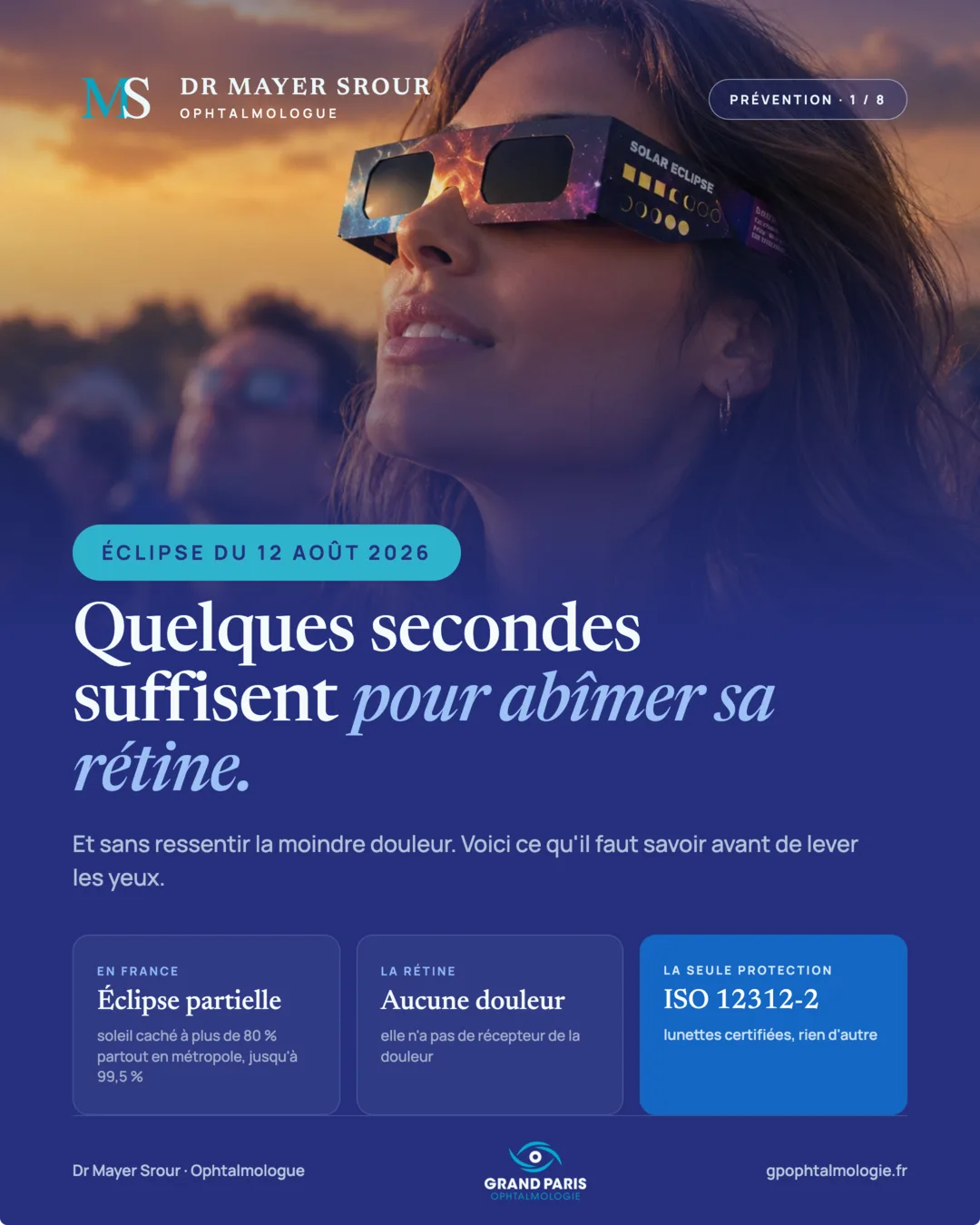
A few seconds are enough to damage your retina
Eclipse of 12 August 2026. And without feeling any pain. Here is what you need to know before looking up.
In France: partial eclipse, sun more than 80% hidden everywhere in mainland France, up to 99.5%. The retina: no pain, because it has no pain receptors. The only protection: ISO 12312-2, certified glasses, nothing else.
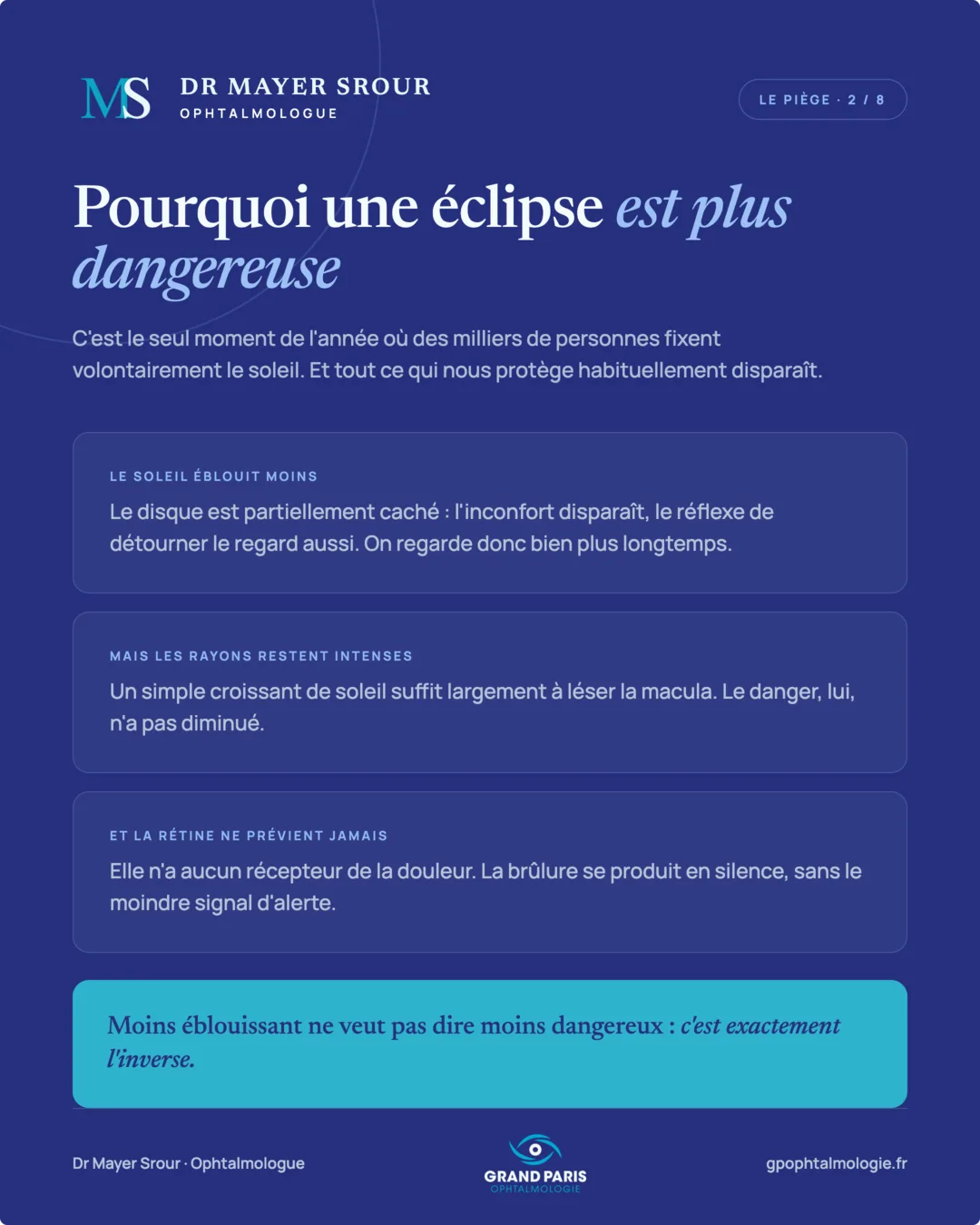
Why an eclipse is more dangerous
It is the only time of year when thousands of people deliberately stare at the sun. And everything that normally protects us disappears.
The sun is less dazzling: the disc is partly hidden, the discomfort disappears, and so does the reflex to look away. So we look for much longer. But the rays remain intense: a mere crescent of sun is more than enough to damage the macula. And the retina never warns you: it has no pain receptors, the burn happens silently.
Less dazzling does not mean less dangerous: it is exactly the opposite.
Solar retinopathy, an invisible burn
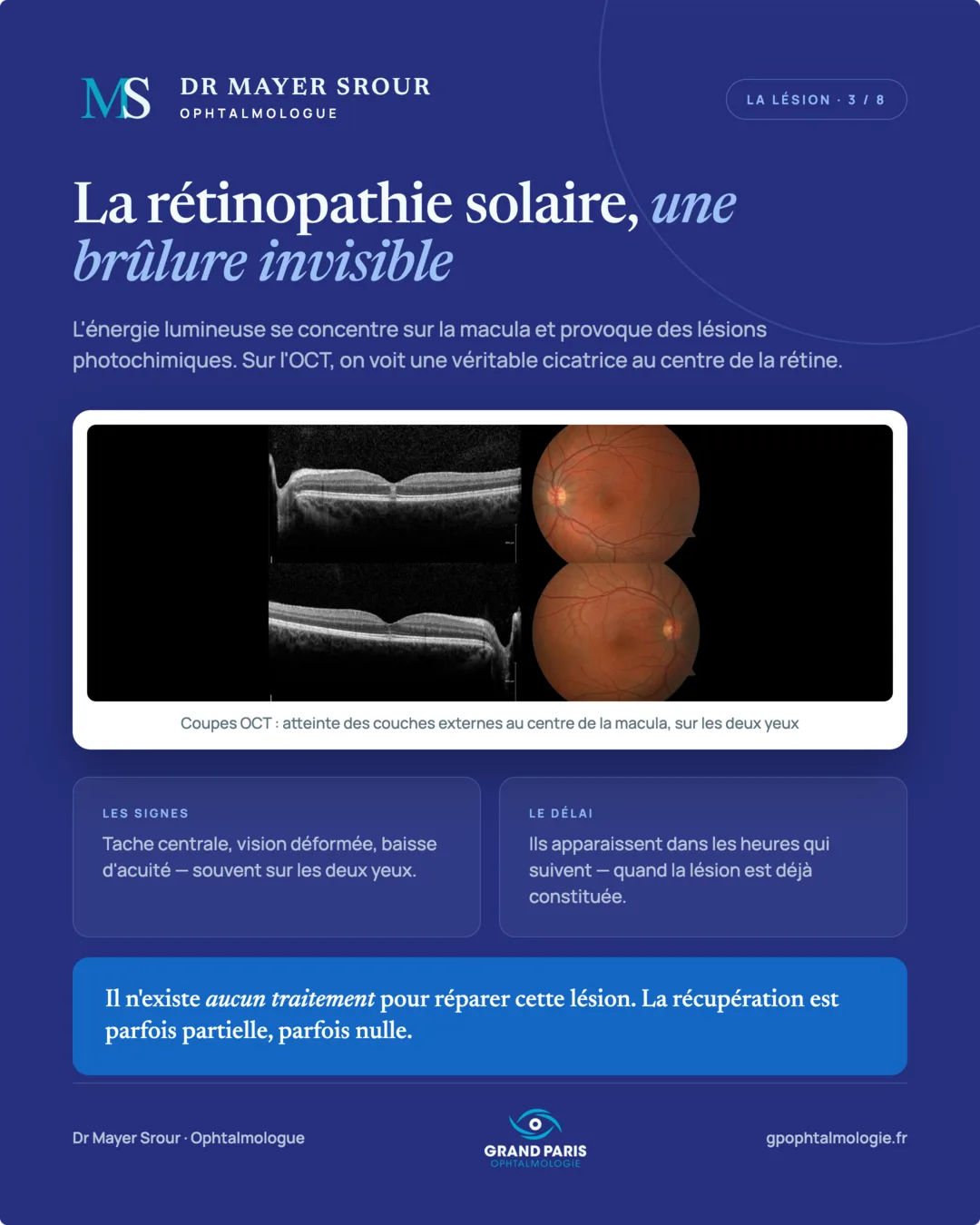
Light energy is concentrated on the macula and causes photochemical damage. On OCT, a genuine scar is visible at the centre of the retina (OCT sections: damage to the outer layers at the centre of the macula, in both eyes).
The signs: central spot, distorted vision, reduced acuity — often in both eyes. The delay: they appear within the hours that follow — when the damage is already done.
There is no treatment to repair this damage. Recovery is sometimes partial, sometimes nil.
Seeing with a spot at the centre
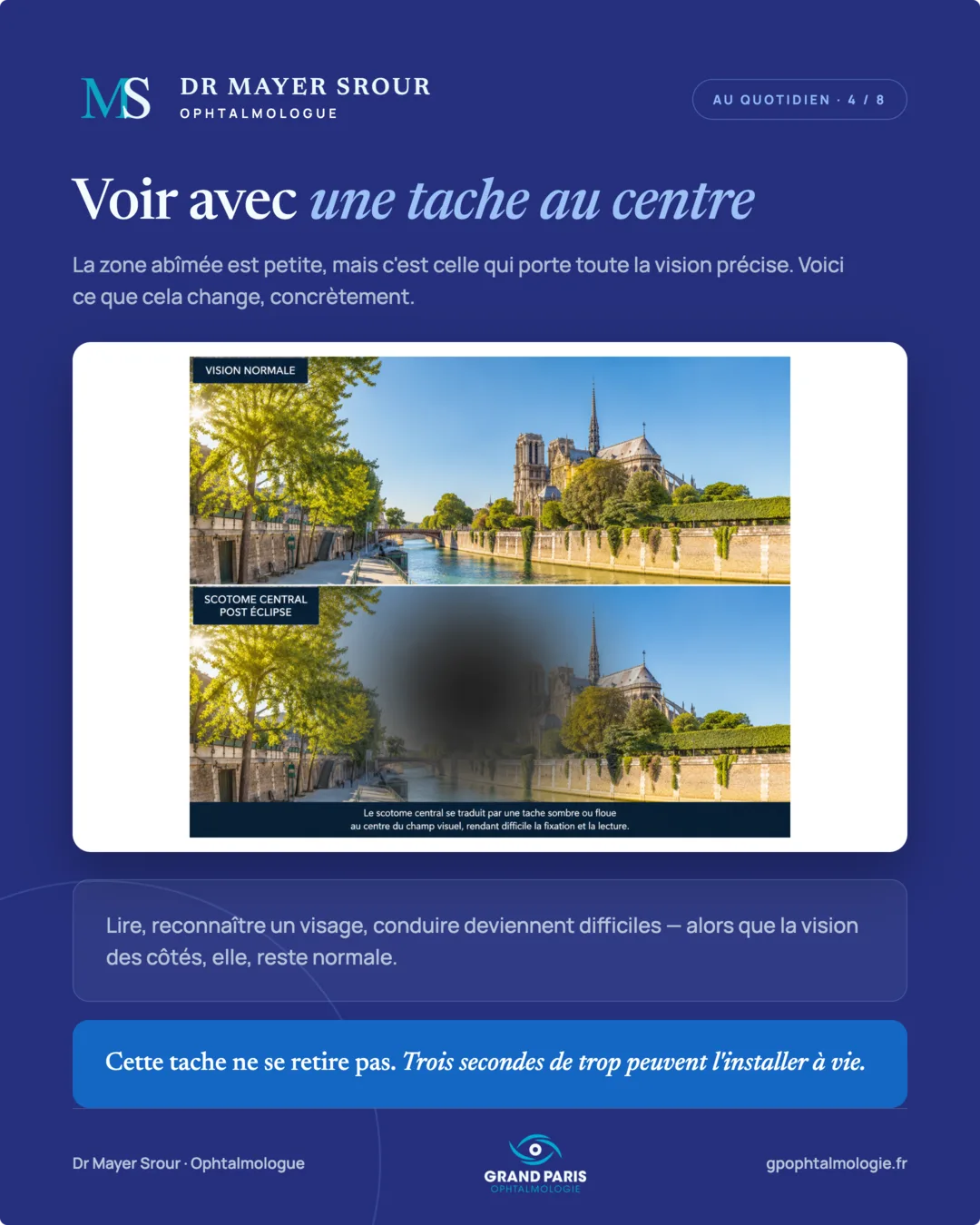
The damaged area is small, but it is the one that carries all fine vision. Reading, recognising a face, driving become difficult — while side vision remains normal.
This spot cannot be removed. Three seconds too many can leave it for life.
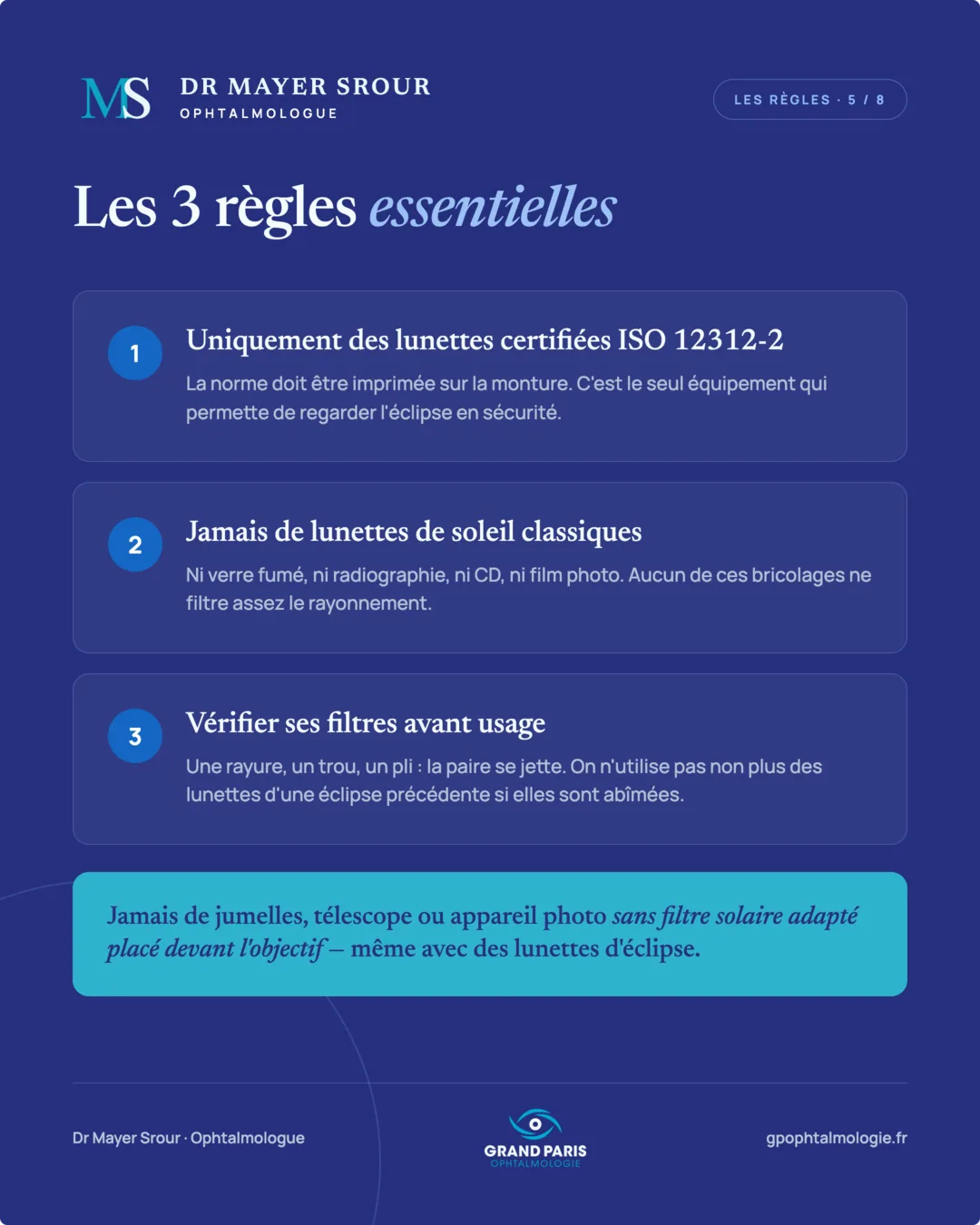
The 3 essential rules
1 · Only glasses certified ISO 12312-2: the standard must be printed on the frame. This is the only equipment that allows you to watch the eclipse safely.
2 · Never ordinary sunglasses: no smoked glass, no X-ray film, no CD, no photographic film. None of these makeshift solutions filters enough of the radiation.
3 · Check your filters before use: a scratch, a hole, a crease — throw the pair away. Do not use glasses from a previous eclipse either if they are damaged.
Never use binoculars, a telescope or a camera without a suitable solar filter placed in front of the lens — even with eclipse glasses.
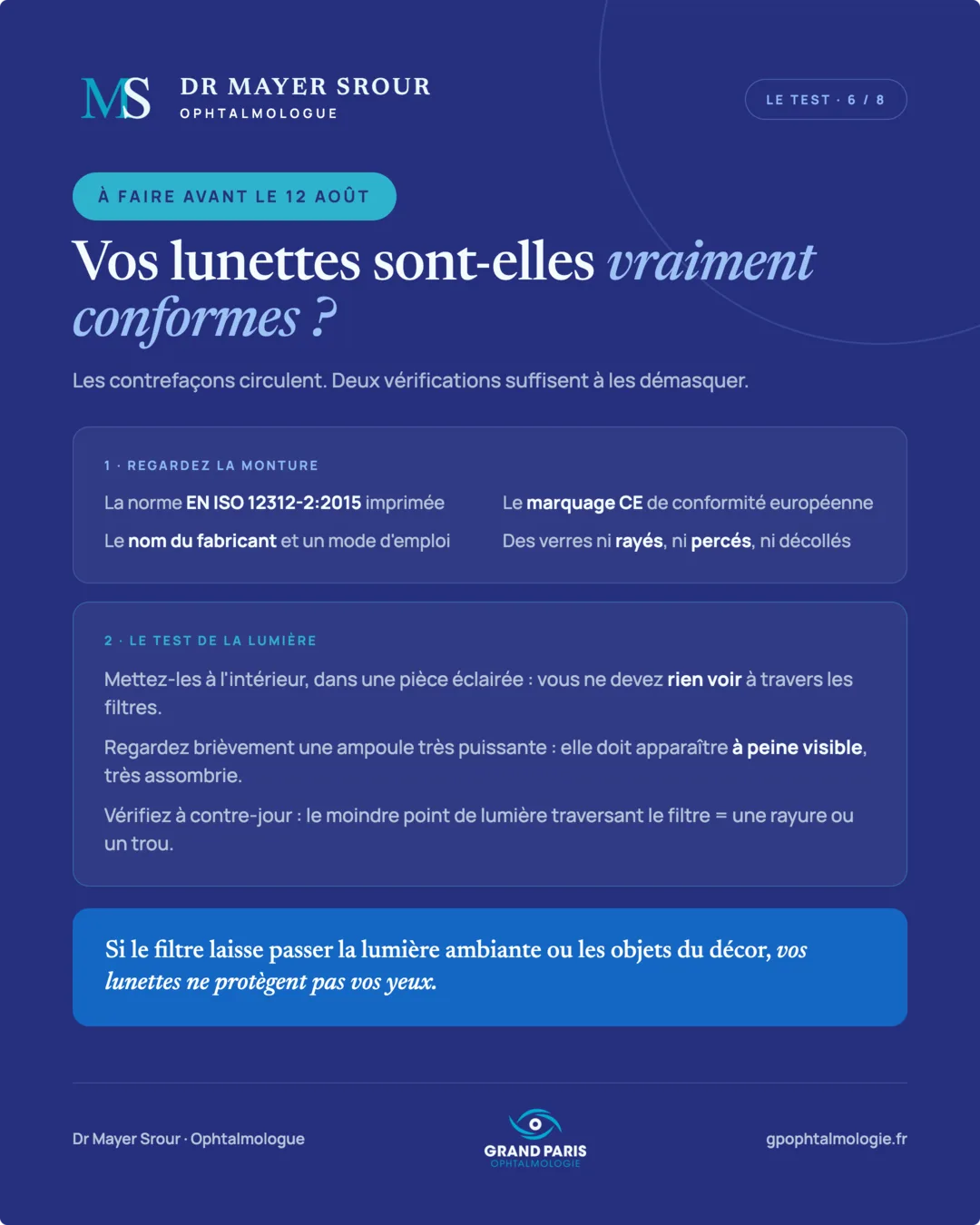
Are your glasses really compliant? The test
Counterfeits are in circulation. Two checks are enough to spot them.
1 · Look at the frame: the standard EN ISO 12312-2:2015 printed on it, the CE marking of European conformity, the manufacturer's name and instructions for use, lenses that are not scratched, pierced or coming unstuck.
2 · The light test: put them on indoors, in a lit room — you must see nothing through the filters. Look briefly at a very bright bulb: it should appear barely visible, very dimmed. Check against the light: the slightest point of light passing through the filter means a scratch or a hole.
If the filter lets through ambient light or the objects around you, your glasses do not protect your eyes.
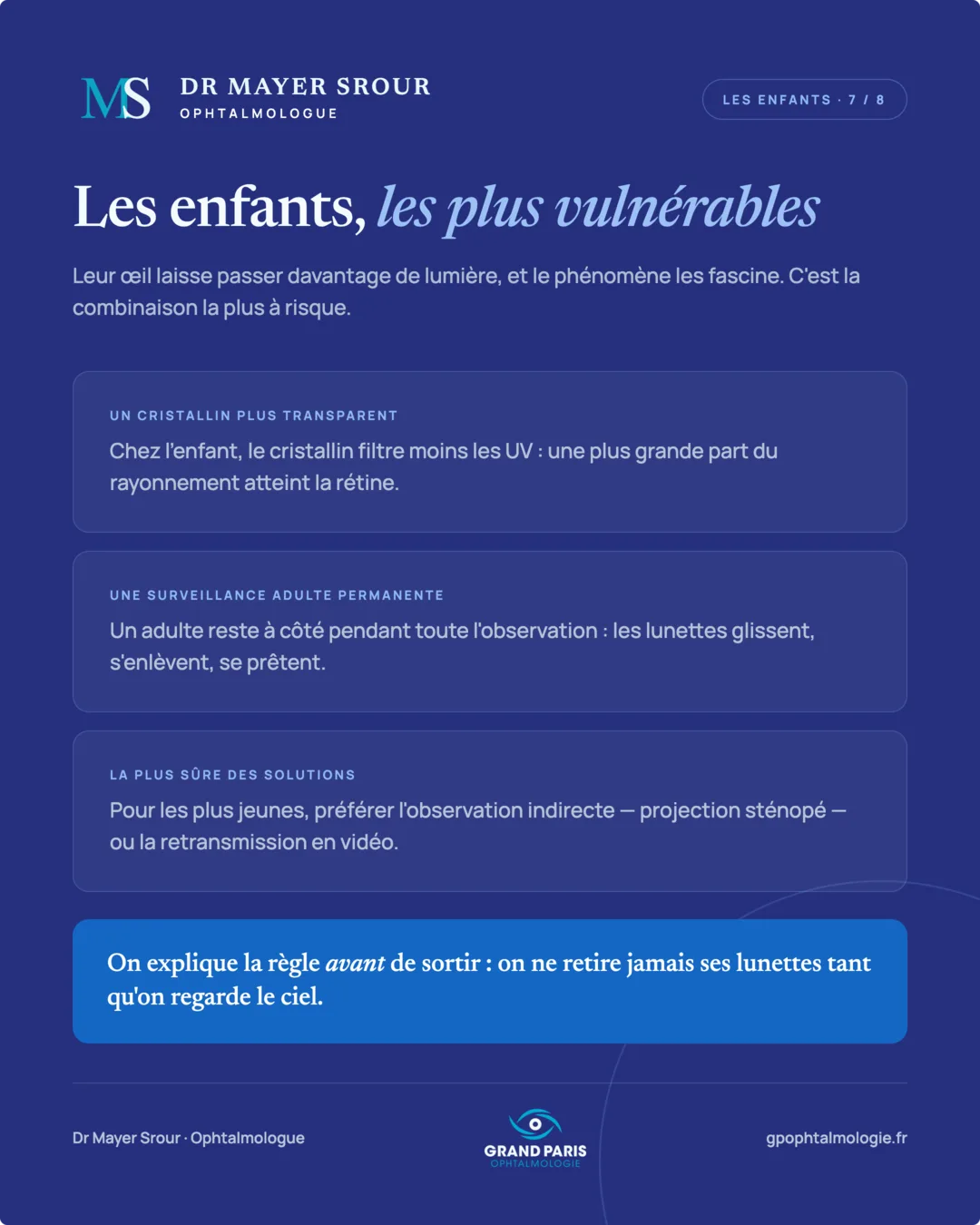
Children, the most vulnerable
Their eyes let in more light, and the phenomenon fascinates them. It is the highest-risk combination.
A clearer lens: in children, the lens filters less UV, so a greater share of the radiation reaches the retina. Constant adult supervision: an adult stays beside them throughout the observation — glasses slip, get taken off, get passed around. The safest solution: for the youngest, prefer indirect observation (pinhole projection) or a video broadcast.
Explain the rule before going out: you never take your glasses off while looking at the sky.
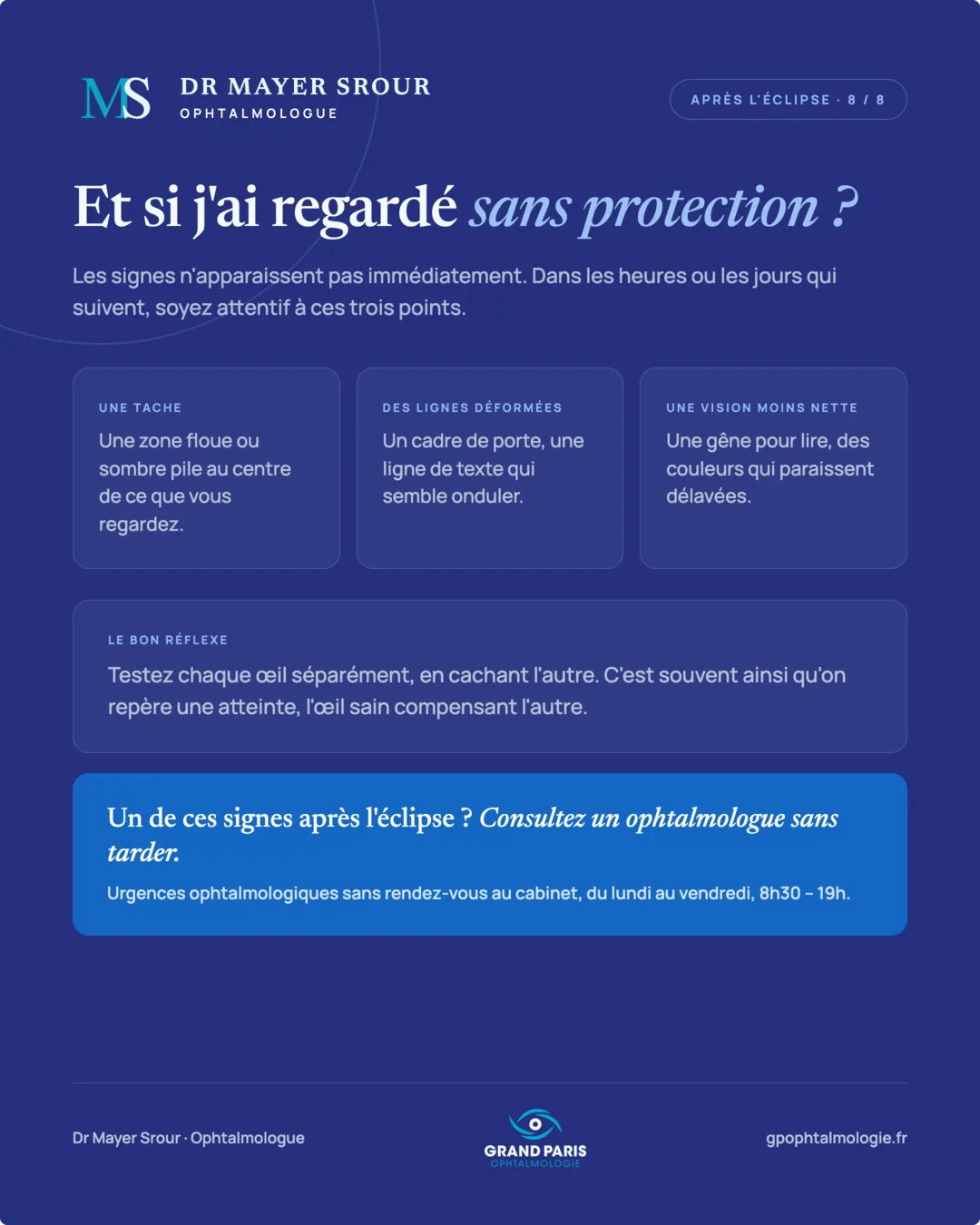
And if I looked without protection?
The signs do not appear immediately. In the hours or days that follow, watch for these three points: a spot (a blurred or dark area right at the centre of what you are looking at); distorted lines (a door frame, a line of text that seems to ripple); less sharp vision (difficulty reading, colours that seem washed out).
The right reflex: test each eye separately, covering the other. This is often how damage is spotted, the healthy eye compensating for the other.
One of these signs after the eclipse? See an ophthalmologist without delay. Eye emergencies without an appointment at the practice, Monday to Friday, 8:30 am – 7 pm. Emergencies are also seen between 1 pm and 2 pm, without a break.
Going further
This carousel summarises the essentials in a few images. The subject is covered in more depth on the dedicated page of the website: Eclipse of 12 August 2026: protecting your eyes (full article).