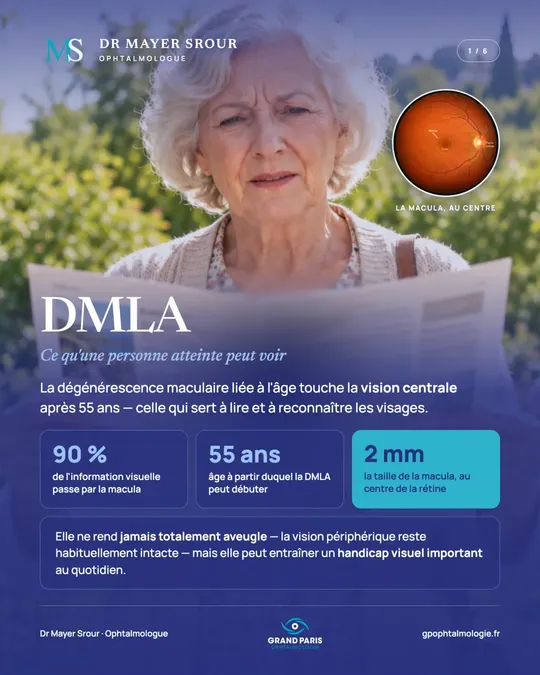
Ozempic, Wegovy, Mounjaro and eye health: benefits, risks… or both?
The optic nerve, the retina of the patient with diabetes, what the major studies from 2024 to 2026 say and what this concretely changes for your eyes. The carousel published on Instagram, image by image.

Swipe, or use the arrows. The text of each image is reproduced below.
The carousel, image by image
The text of each carousel page, to read at your leisure or to find a specific piece of information.
Ozempic, Wegovy, Mounjaro and eye health
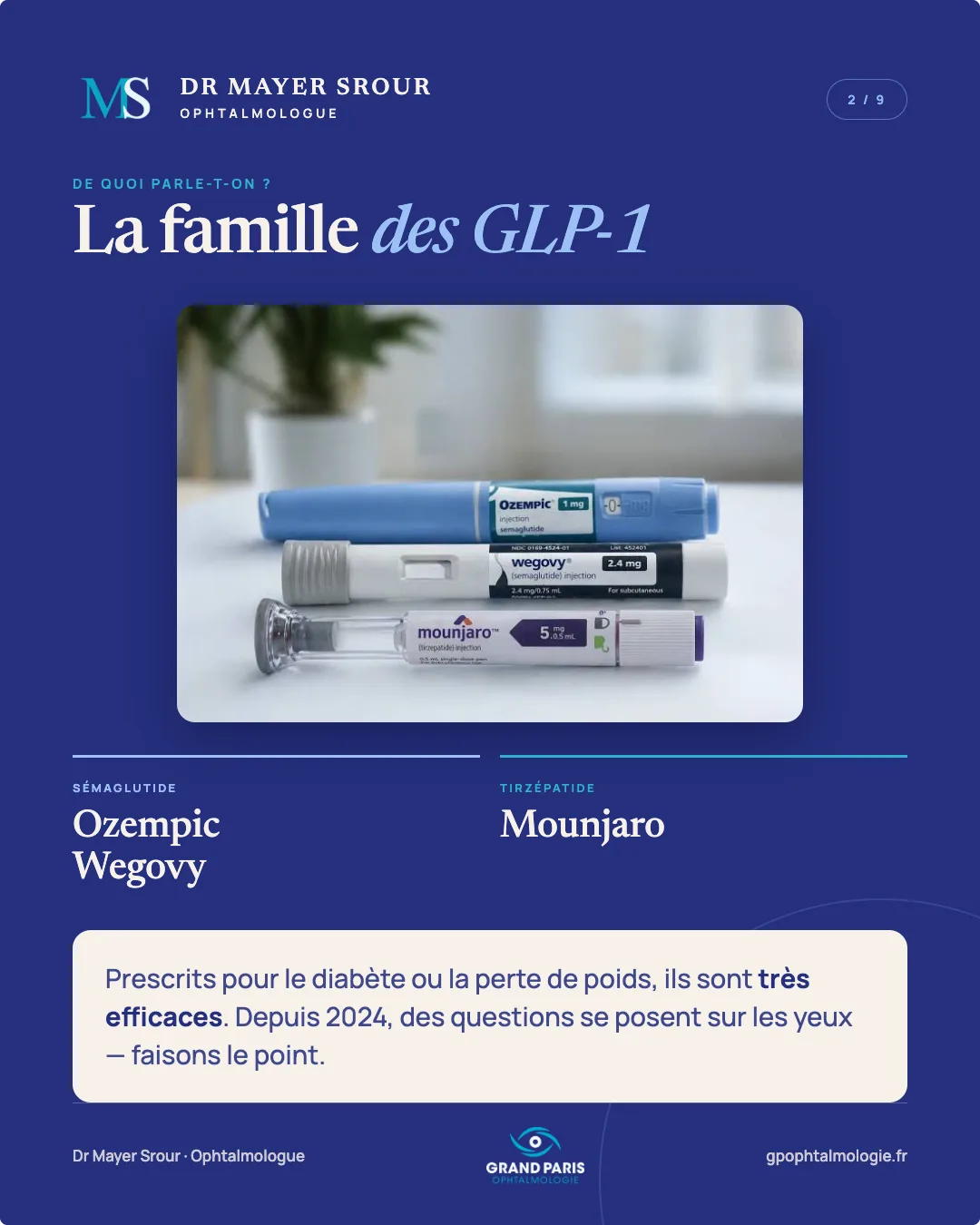
Benefits, risks… or both? Cover image of the carousel, with the three injector pens (semaglutide 0.25 mg, 2.4 mg and tirzepatide 5 mg).
What are we talking about? The GLP-1 family
Semaglutide: Ozempic, Wegovy. Tirzepatide: Mounjaro.
Prescribed for diabetes or weight loss, they are very effective. Since 2024, questions have been raised about the eyes — let us take stock.
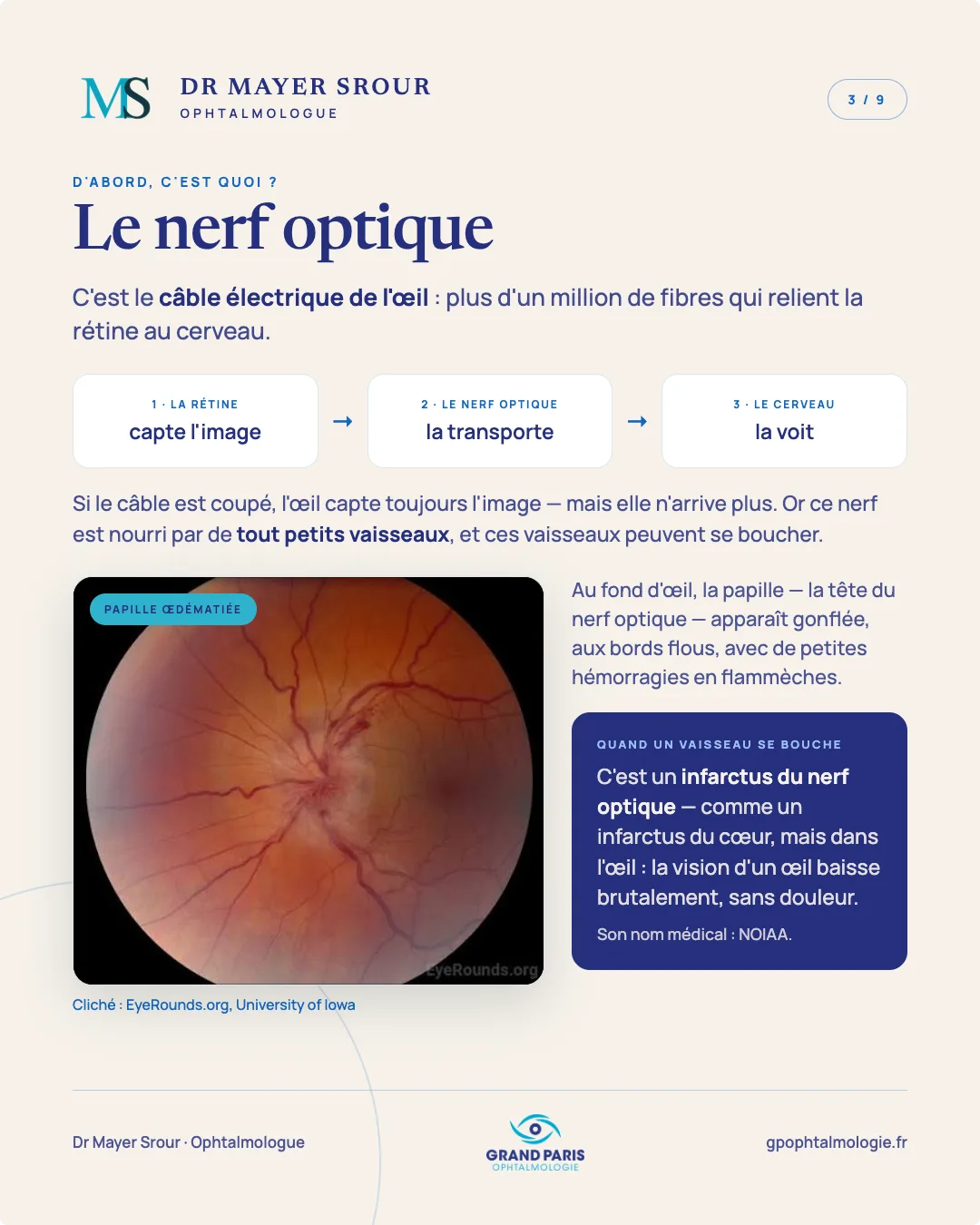
First, what is it? The optic nerve
It is the electrical cable of the eye: more than a million fibres connecting the retina to the brain. The retina captures the image, the optic nerve carries it, the brain sees it.
If the cable is cut, the eye still captures the image — but it no longer arrives. Yet this nerve is fed by tiny blood vessels, and these vessels can become blocked.
Swollen optic disc: on fundus examination, the optic disc — the head of the optic nerve — appears swollen, with blurred edges, with small flame-shaped haemorrhages (photograph: EyeRounds.org, University of Iowa).
When a vessel becomes blocked, it is an infarction of the optic nerve — like a heart attack, but in the eye: vision in one eye drops suddenly, without pain. Its medical name: NAION.
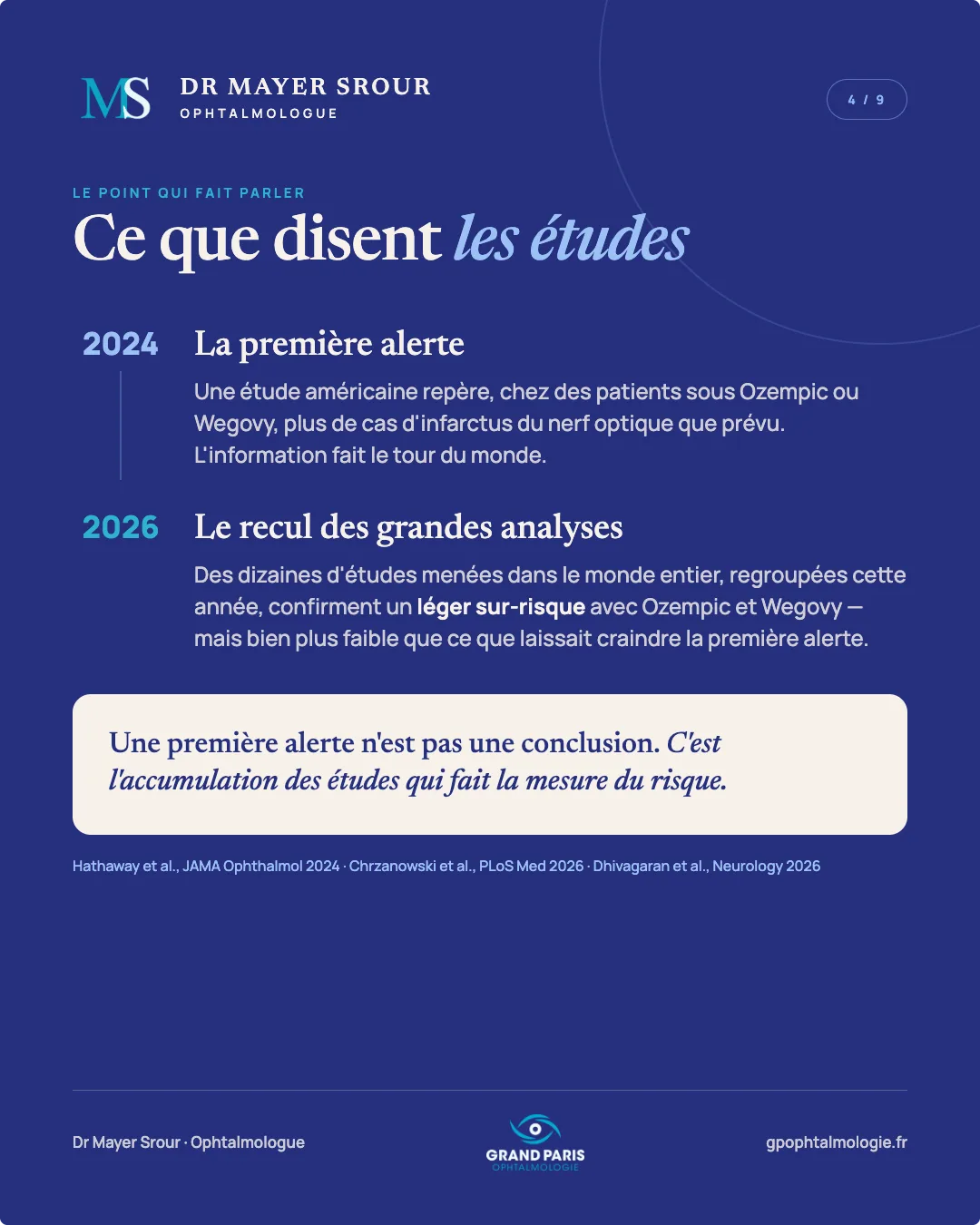
What the studies say
2024, the first warning: a US study finds more cases of optic nerve infarction than expected in patients taking Ozempic or Wegovy. The news goes around the world.
2026, the perspective of large analyses: dozens of studies from around the world, pooled this year, confirm a slight excess risk with Ozempic and Wegovy — but much lower than the first warning had led people to fear.
A first warning is not a conclusion. It is the accumulation of studies that measures the risk.
Hathaway et al., JAMA Ophthalmol 2024 · Chrzanowski et al., PLoS Med 2026 · Dhivagaran et al., Neurology 2026.
Optic nerve infarction (NAION): very rare, but real
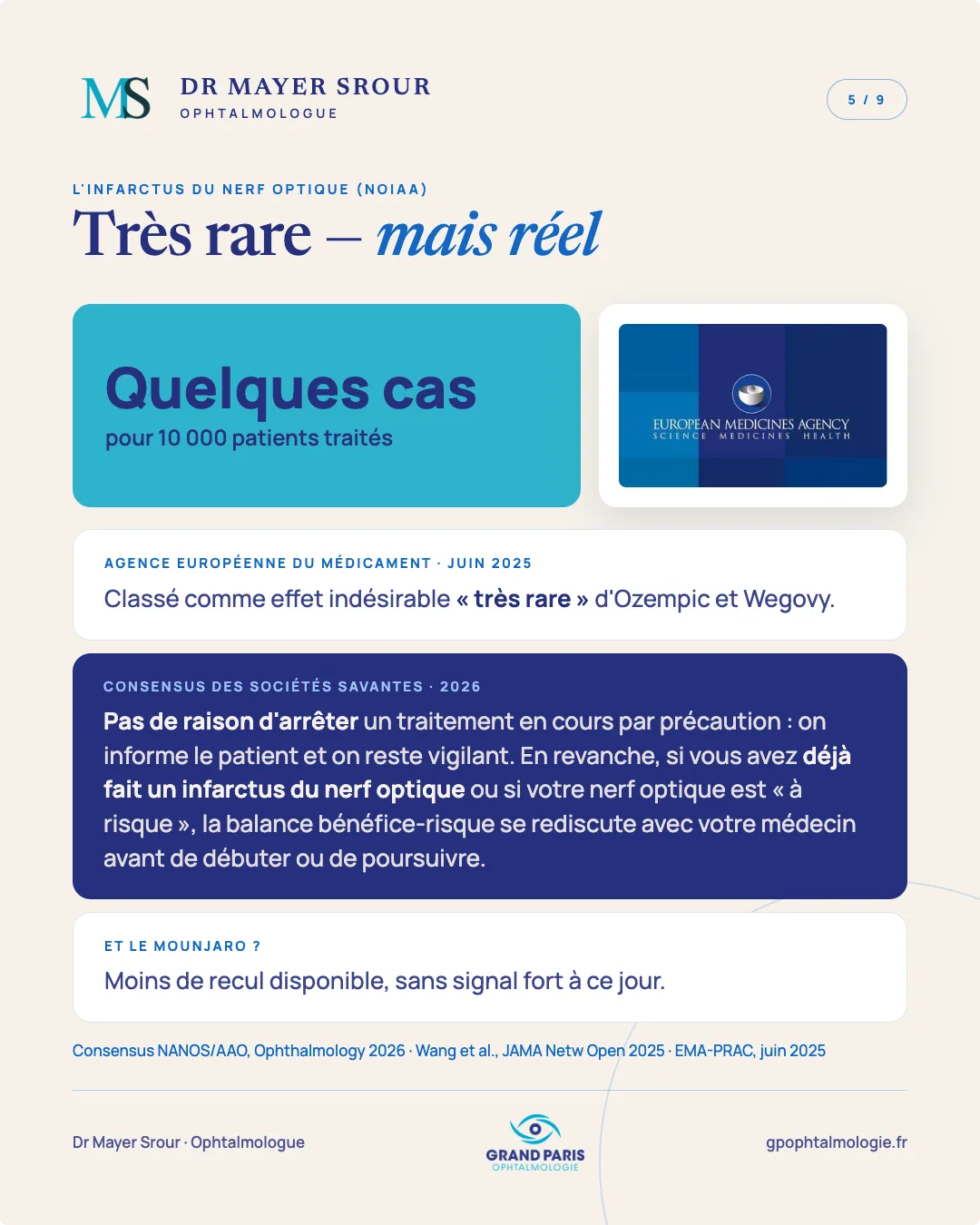
A few cases per 10,000 patients treated. European Medicines Agency, June 2025: classified as a “very rare” adverse effect of Ozempic and Wegovy.
Professional societies' consensus, 2026: no reason to stop an ongoing treatment as a precaution — the patient is informed and vigilance is maintained. However, if you have already had an optic nerve infarction or if your optic nerve is “at risk”, the benefit-risk balance should be discussed again with your doctor before starting or continuing.
And Mounjaro? Less follow-up is available, with no strong signal to date.
NANOS/AAO consensus, Ophthalmology 2026 · Wang et al., JAMA Netw Open 2025 · EMA-PRAC, June 2025.
If you have diabetes: the retina, in the first months
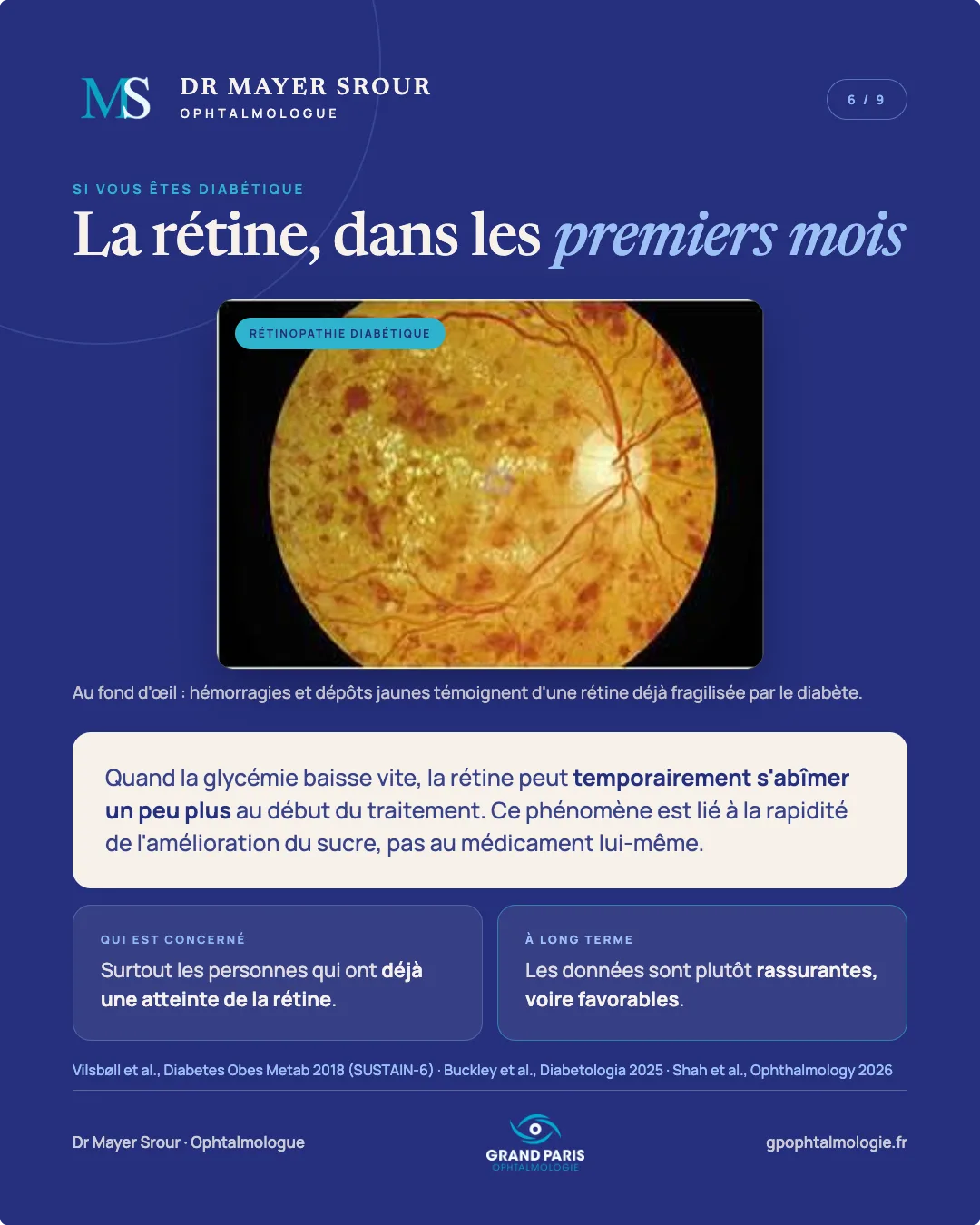
Diabetic retinopathy: on fundus examination, haemorrhages and yellow deposits show a retina already weakened by diabetes.
When blood sugar falls quickly, the retina can temporarily worsen a little at the start of treatment. This phenomenon is linked to the speed of the improvement in blood sugar, not to the medication itself.
Who is affected: mainly people who already have retinal damage. In the long term, the data are rather reassuring, even favourable.
Vilsbøll et al., Diabetes Obes Metab 2018 (SUSTAIN-6) · Buckley et al., Diabetologia 2025 · Shah et al., Ophthalmology 2026.
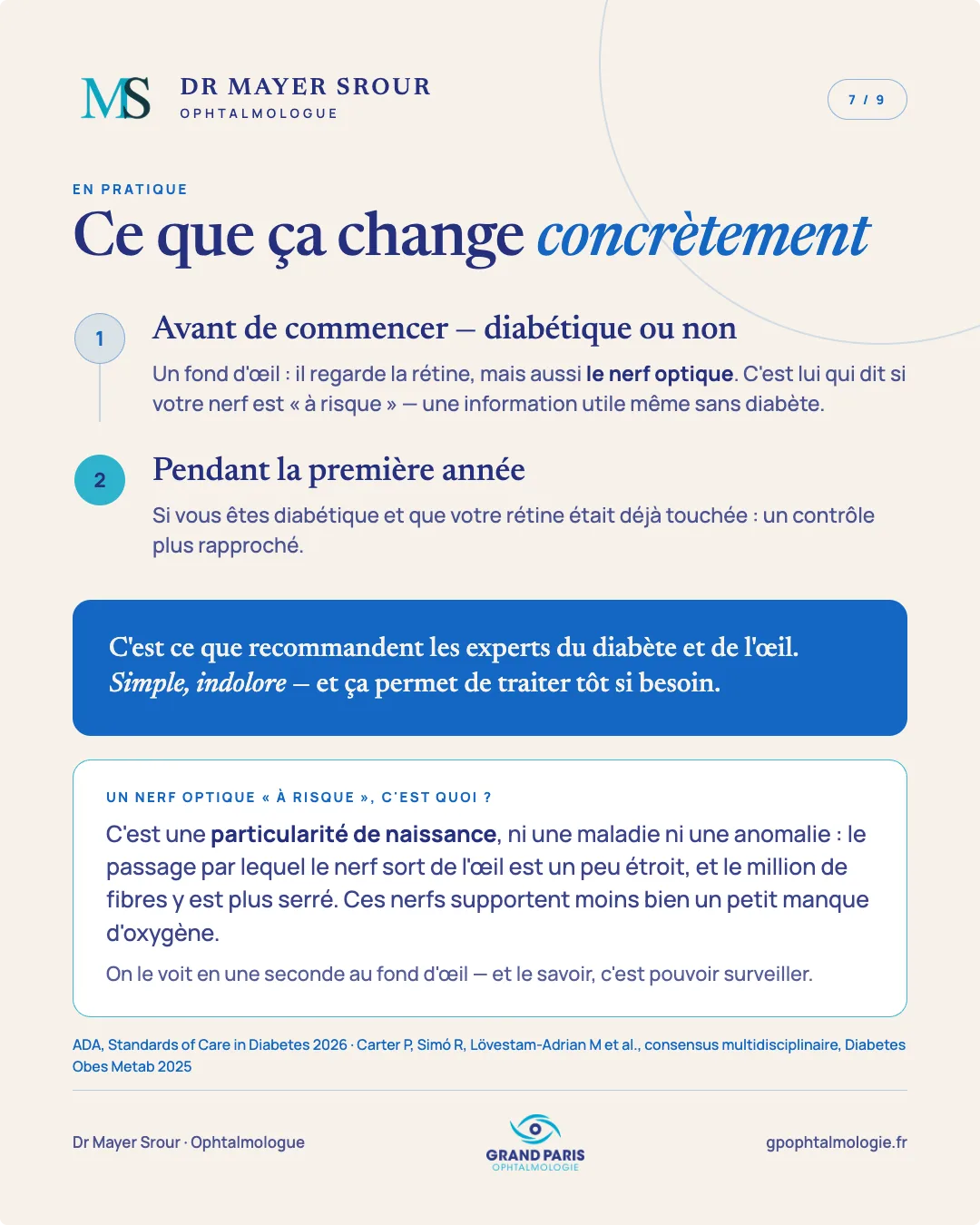
In practice: what it concretely changes
1 · Before starting — with or without diabetes: a fundus examination. It looks at the retina, but also at the optic nerve. It shows whether your nerve is “at risk” — useful information even without diabetes.
2 · During the first year: if you have diabetes and your retina was already affected, closer monitoring. This is what diabetes and eye experts recommend. Simple, painless — and it allows early treatment if needed.
What is an “at-risk” optic nerve? A feature present from birth, neither a disease nor an abnormality: the passage through which the nerve leaves the eye is a little narrow, and the million fibres are more tightly packed there. These nerves tolerate a small lack of oxygen less well. It is seen in a second on fundus examination — and knowing it means being able to monitor it.
ADA, Standards of Care in Diabetes 2026 · Carter P, Simó R, Lövestam-Adrian M et al., multidisciplinary consensus, Diabetes Obes Metab 2025.
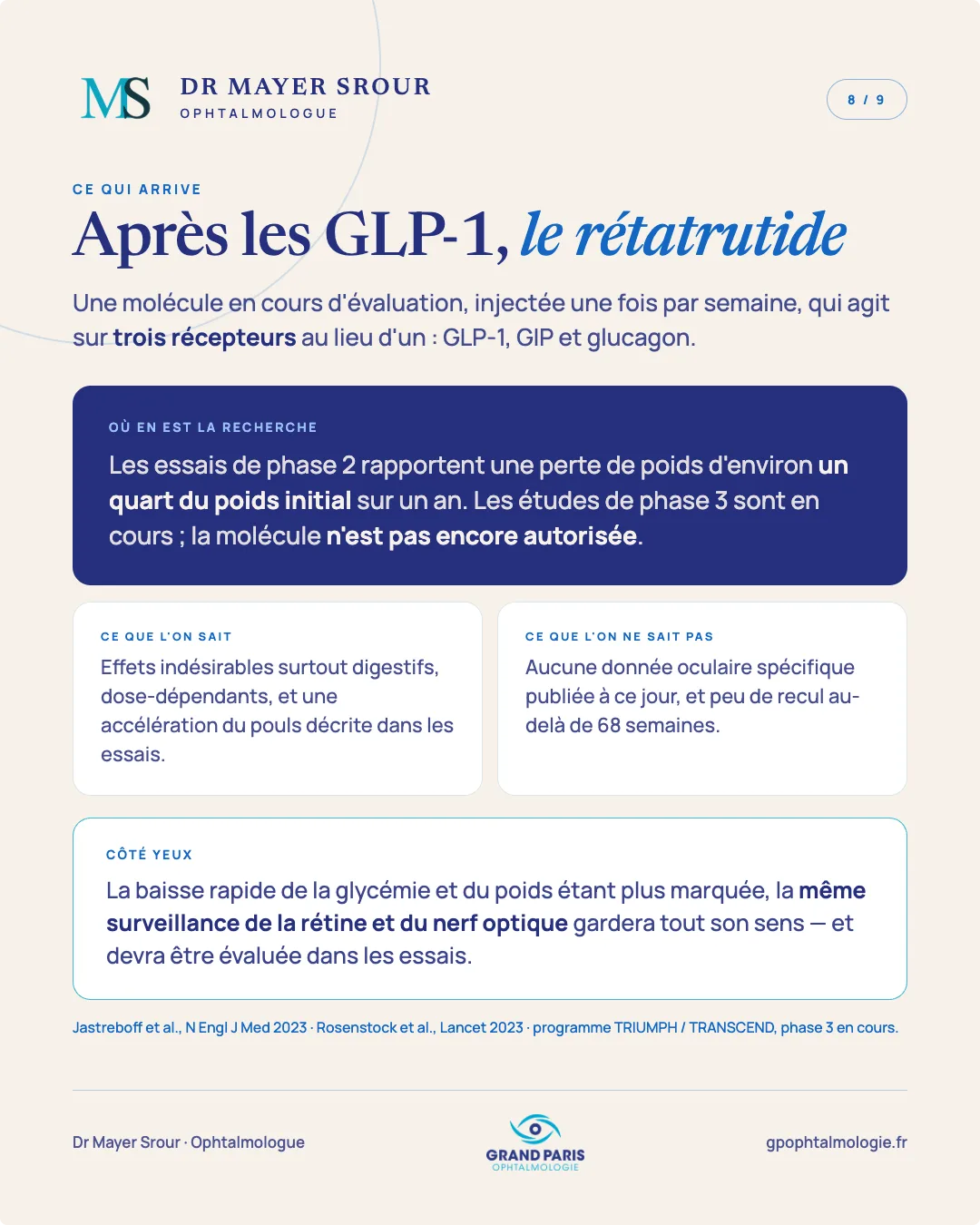
What is coming: after GLP-1, retatrutide
A molecule under evaluation, injected once a week, which acts on three receptors instead of one: GLP-1, GIP and glucagon.
Where research stands: phase 2 trials report weight loss of about a quarter of initial body weight over a year. Phase 3 studies are under way; the molecule is not yet authorised.
What is known: mainly digestive side effects, dose-dependent, and an increase in heart rate described in the trials. What is not known: no specific eye data published to date, and little follow-up beyond 68 weeks.
For the eyes: since the drop in blood sugar and weight is more marked, the same monitoring of the retina and optic nerve will remain relevant — and will need to be evaluated in the trials.
Jastreboff et al., N Engl J Med 2023 · Rosenstock et al., Lancet 2023 · TRIUMPH / TRANSCEND programme, phase 3 under way.
Overall: benefit-risk, the balance tips
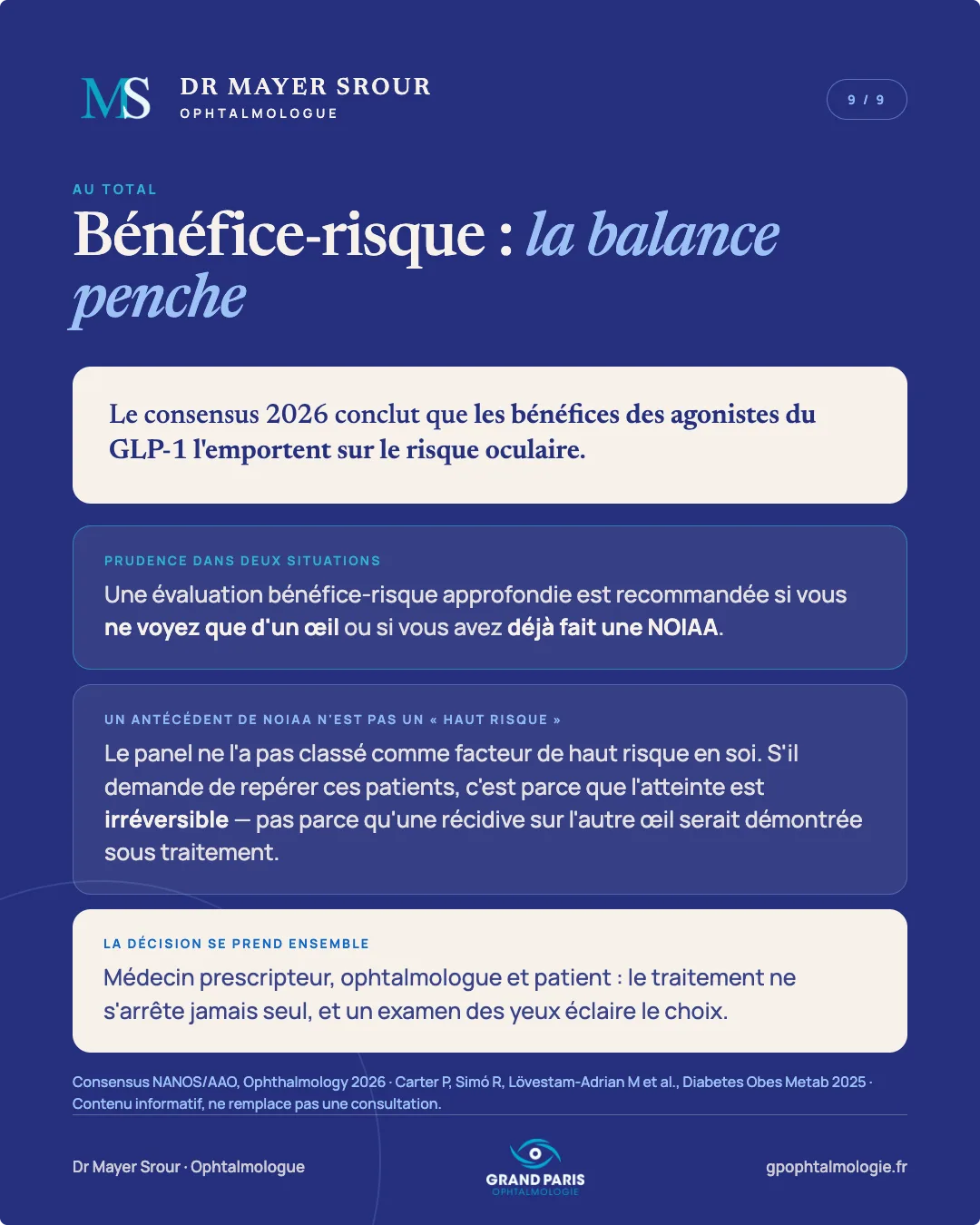
The 2026 consensus concludes that the benefits of GLP-1 agonists outweigh the eye risk.
Caution in two situations: an in-depth benefit-risk assessment is recommended if you have sight in only one eye or if you have already had NAION.
A history of NAION is not “high risk”: the panel did not classify it as a high-risk factor in itself. If it asks for these patients to be identified, it is because the damage is irreversible — not because a recurrence in the other eye has been shown under treatment.
The decision is made together: prescribing doctor, ophthalmologist and patient. Treatment is never stopped on your own, and an eye examination informs the choice.
NANOS/AAO consensus, Ophthalmology 2026 · Carter P, Simó R, Lövestam-Adrian M et al., Diabetes Obes Metab 2025. For information only; does not replace a consultation.
Going further
This carousel summarises the essentials in a few images. The subject is covered in more depth on the dedicated page of the website: Ozempic, Wegovy, Mounjaro and eye health (full article).