A child never says they can't see well: the signs and key screening dates
They think everyone sees the way they do. So it is up to adults to spot the signs and have their vision checked. The 6 signs, myopia, the 5 key checks, the first examination, screens age by age: the carousel published on Instagram, in 8 images.
Swipe, or use the arrows. The text of each image is reproduced below.
The carousel, image by image
The text of each carousel page, to read at your leisure or to find a specific piece of information.
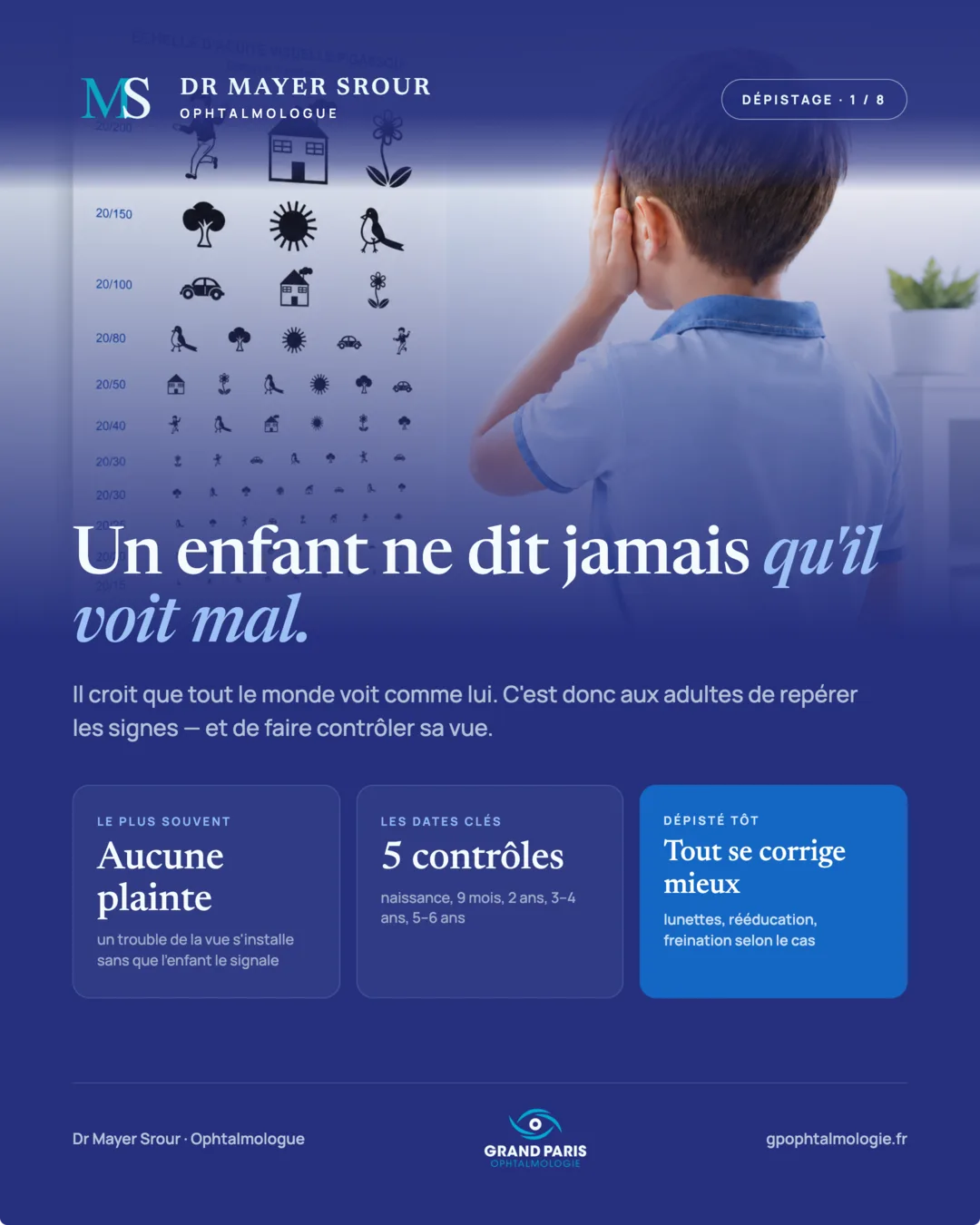
A child never says they can’t see well
They think everyone sees the way they do. So it is up to adults to spot the signs — and have their vision checked.
Most often: no complaint at all, a vision problem sets in without the child mentioning it. The key dates: 5 checks — birth, 9 months, 2 years, 3-4 years, 5-6 years. Caught early, everything is easier to correct: glasses, rehabilitation, myopia control depending on the case.
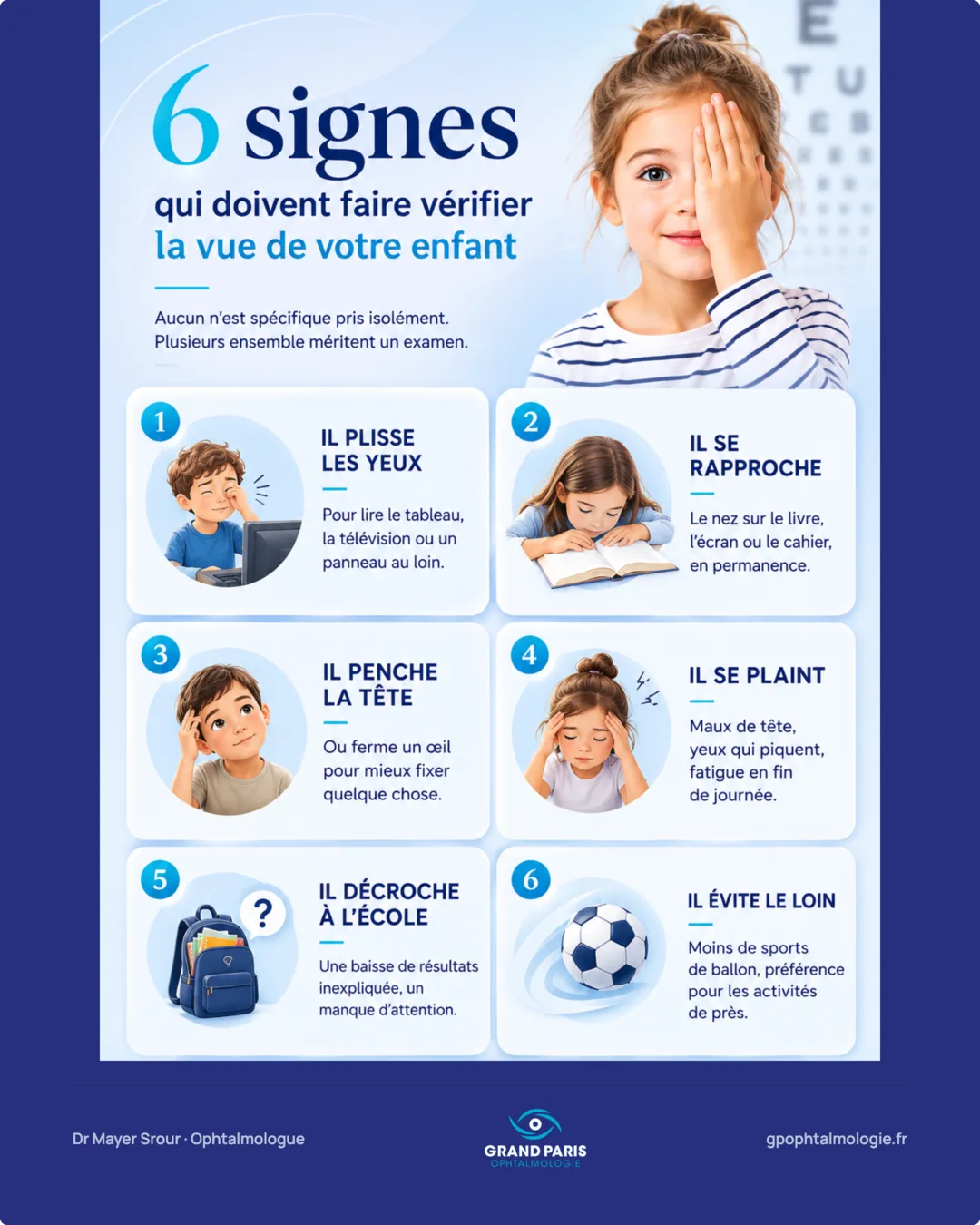
6 signs that should prompt a check of your child's vision
None is specific on its own. Several together warrant an examination.
1 · Squinting to read the board, the television or a sign in the distance. 2 · Getting close: nose on the book, the screen or the notebook, all the time. 3 · Tilting the head, or closing one eye to focus better on something. 4 · Complaining: headaches, stinging eyes, tiredness at the end of the day. 5 · Falling behind at school: unexplained drop in results, lack of attention. 6 · Avoiding distance: fewer ball sports, a preference for close-up activities.
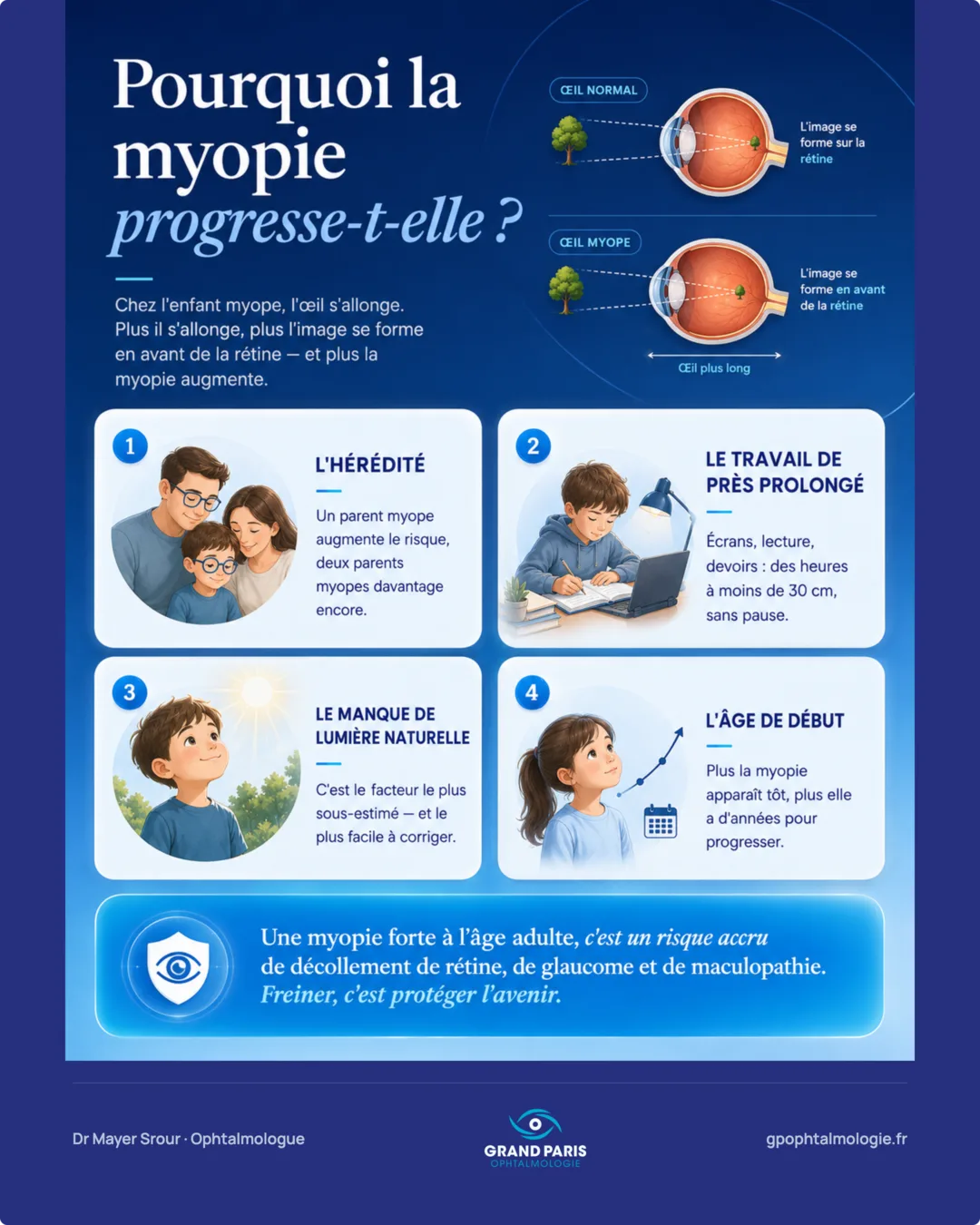
Why does myopia progress?
In a child with myopia, the eye lengthens. The longer it gets, the more the image forms in front of the retina — and the more the myopia increases.
1 · Heredity: one parent with myopia raises the risk, two parents with myopia even more. 2 · Prolonged close work: screens, reading, homework at less than 30 cm, without breaks. 3 · Lack of natural light: this is the most underestimated factor — and the easiest to correct. 4 · Age of onset: the earlier myopia appears, the more years it has to progress.
High myopia in adulthood means an increased risk of retinal detachment, glaucoma and maculopathy. Slowing it down means protecting the future.
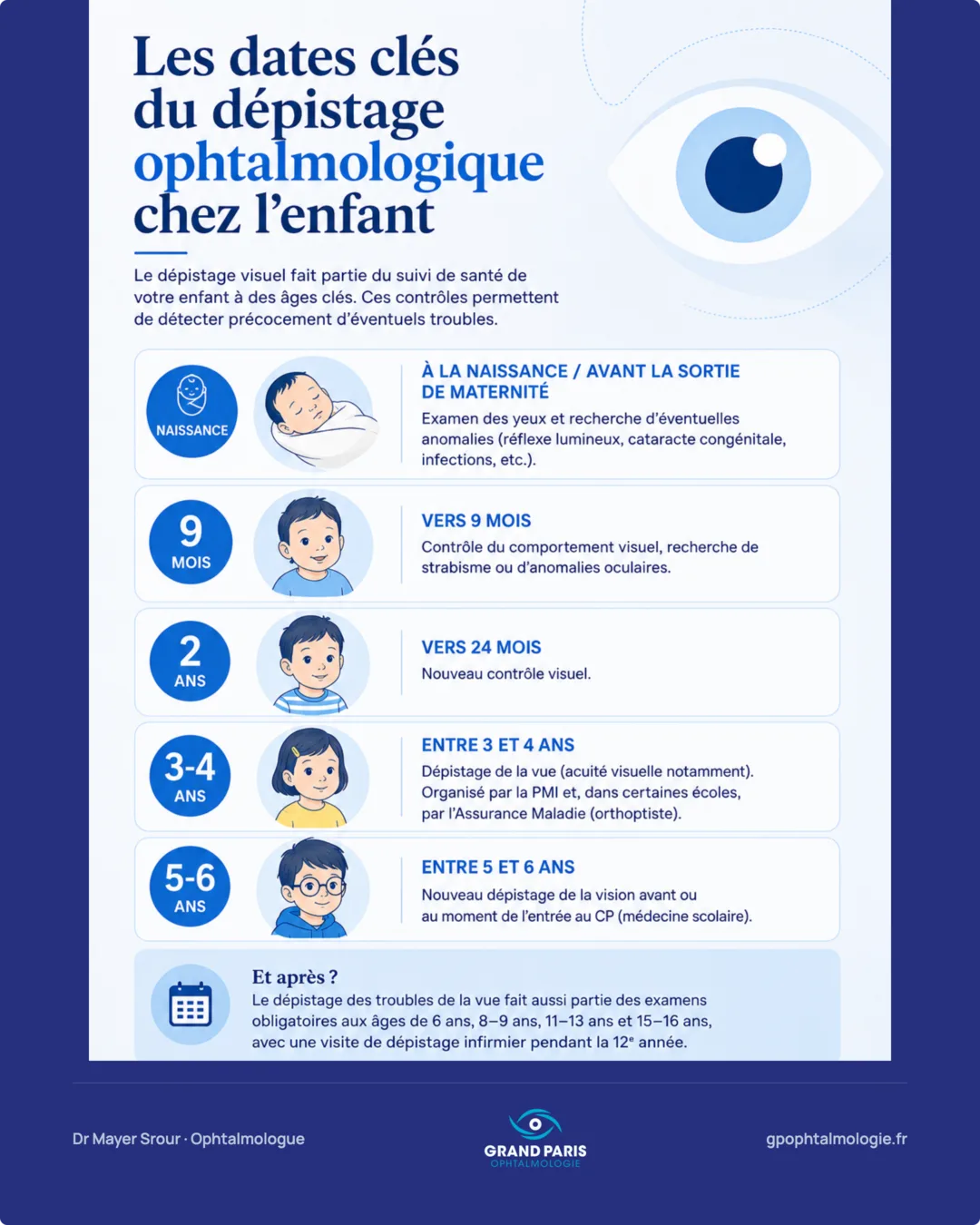
Key dates for children's eye screening
Vision screening is part of your child's health follow-up at key ages. These checks make it possible to detect any problems early.
At birth / before leaving the maternity ward: examination of the eyes and search for any abnormalities (light reflex, congenital cataract, infections…). Around 9 months: check of visual behaviour, search for strabismus or eye abnormalities. Around 24 months: another vision check. Between 3 and 4 years: vision screening (visual acuity in particular), organised by the PMI (the French maternal and child health service) and, in some schools, by the Assurance Maladie (French national health insurance) (orthoptist). Between 5 and 6 years: another vision screening before or at the start of CP (the first year of primary school) (school health service).
And after that? Screening for vision problems is also part of the compulsory examinations at ages 6, 8-9, 11-13 and 15-16, with a nurse screening visit during the 12th year.
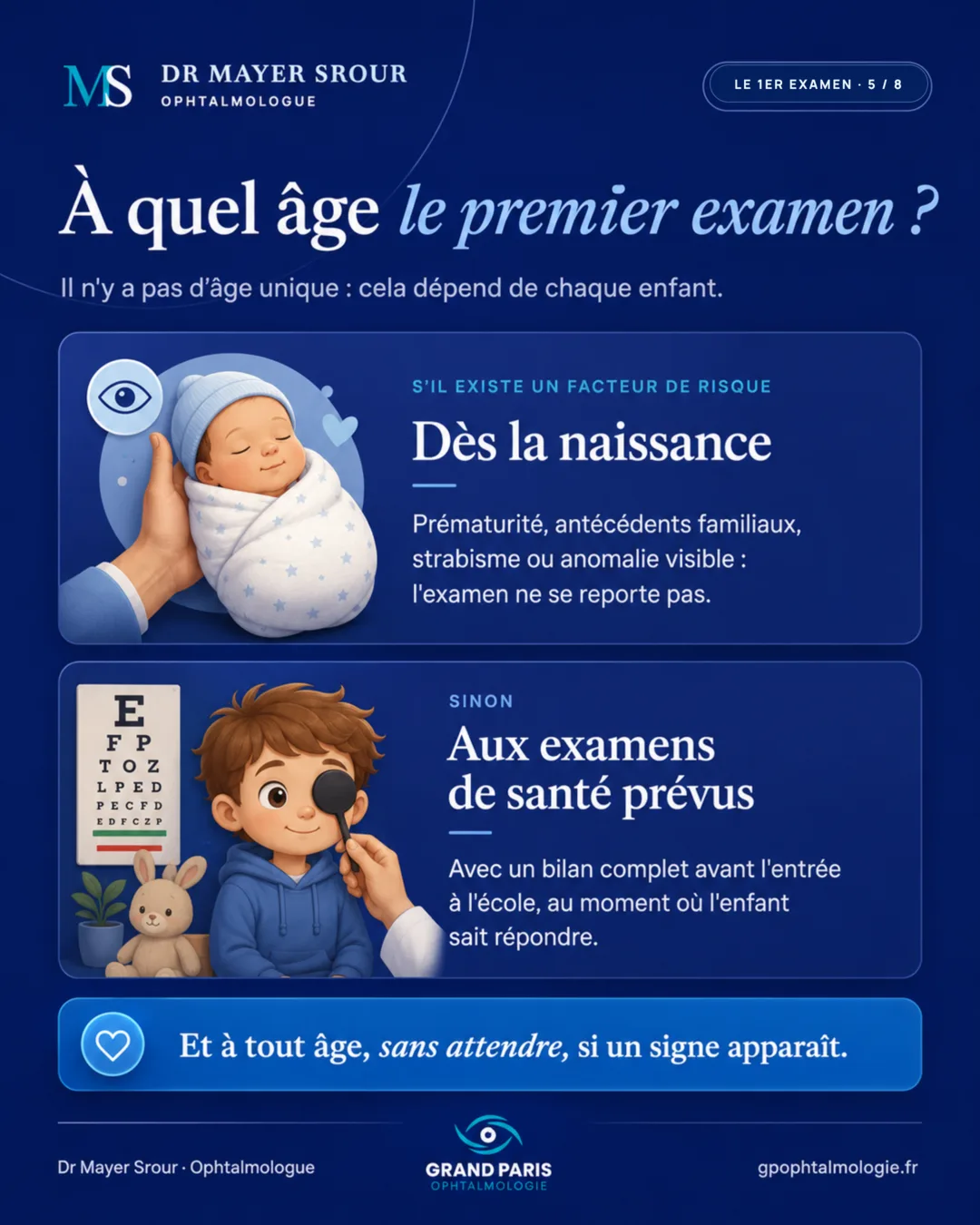
At what age should the first examination take place?
There is no single age: it depends on each child.
If there is a risk factor, from birth: prematurity, family history, strabismus or a visible abnormality — the examination should not be postponed.
Otherwise, at the scheduled health check-ups, with a complete assessment before starting school, when the child is able to respond.
And at any age, without waiting, if a sign appears.
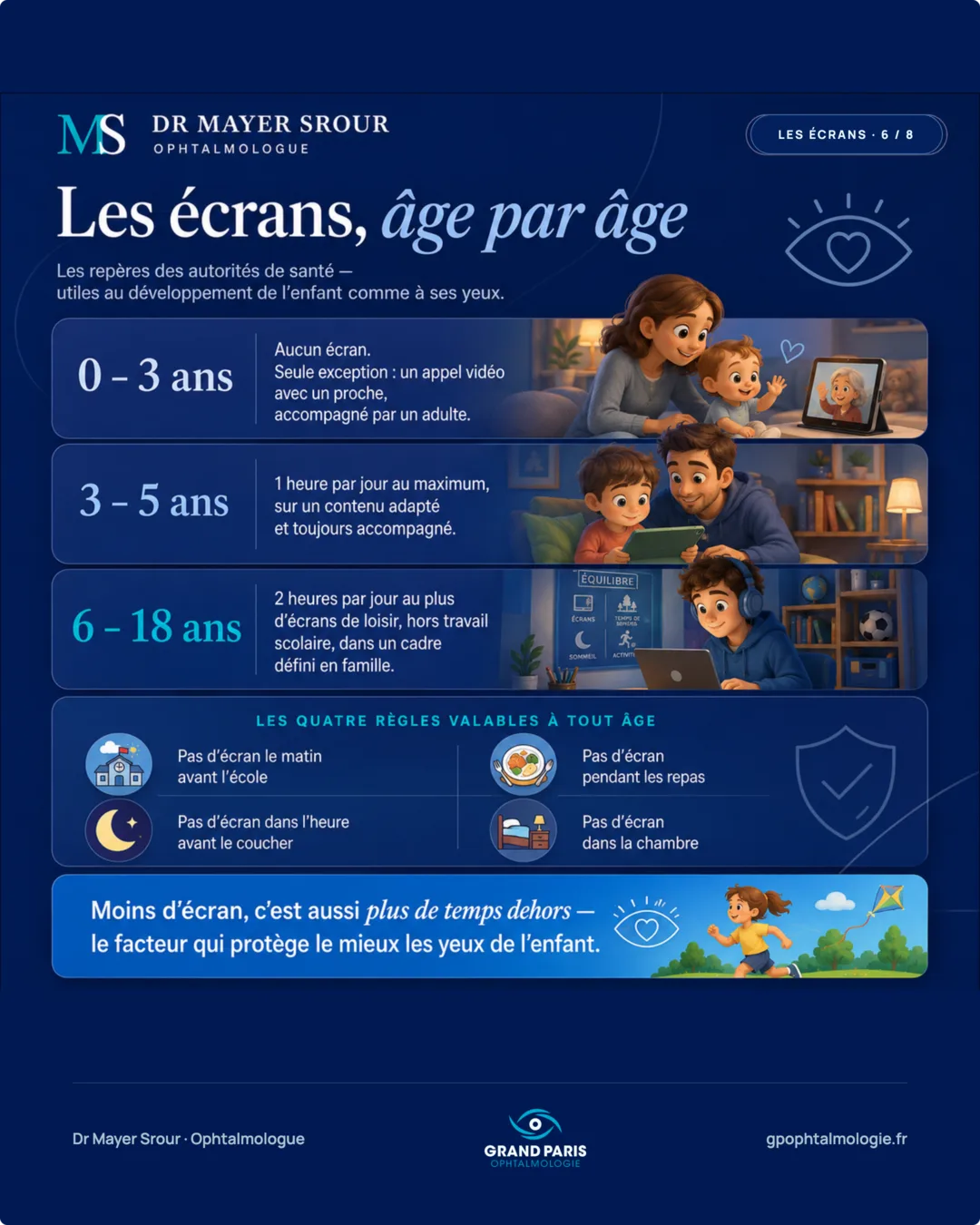
Screens, age by age
Guidance from the health authorities — useful for a child's development as well as for their eyes.
0-3 years: no screens. The only exception is a video call with a relative, with an adult present. 3-5 years: 1 hour a day at most, with suitable content and always accompanied. 6-18 years: 2 hours a day at most of recreational screen time, excluding schoolwork, within a framework set by the family.
The four rules that apply at any age: no screen in the morning before school, no screen during meals, no screen in the hour before bedtime, no screen in the bedroom.
Less screen time also means more time outdoors — the factor that best protects a child's eyes.
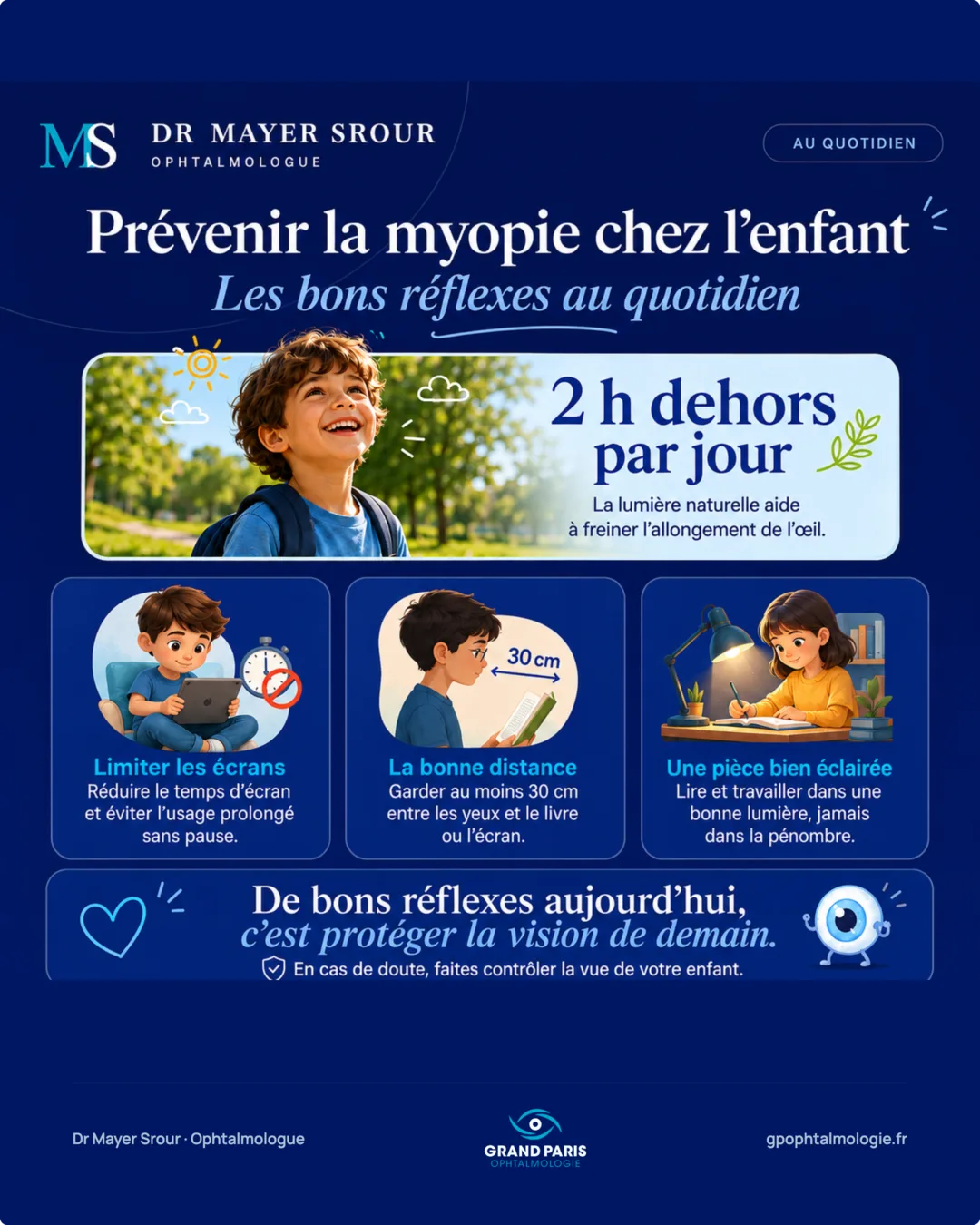
Preventing myopia in children: good everyday habits
2 hours outdoors a day: natural light helps slow the lengthening of the eye.
Limit screens: reduce screen time and avoid prolonged use without breaks. The right distance: keep at least 30 cm between the eyes and the book or screen. A well-lit room: read and work in good light, never in dim light.
Good habits today protect tomorrow's vision. If in doubt, have your child's vision checked.
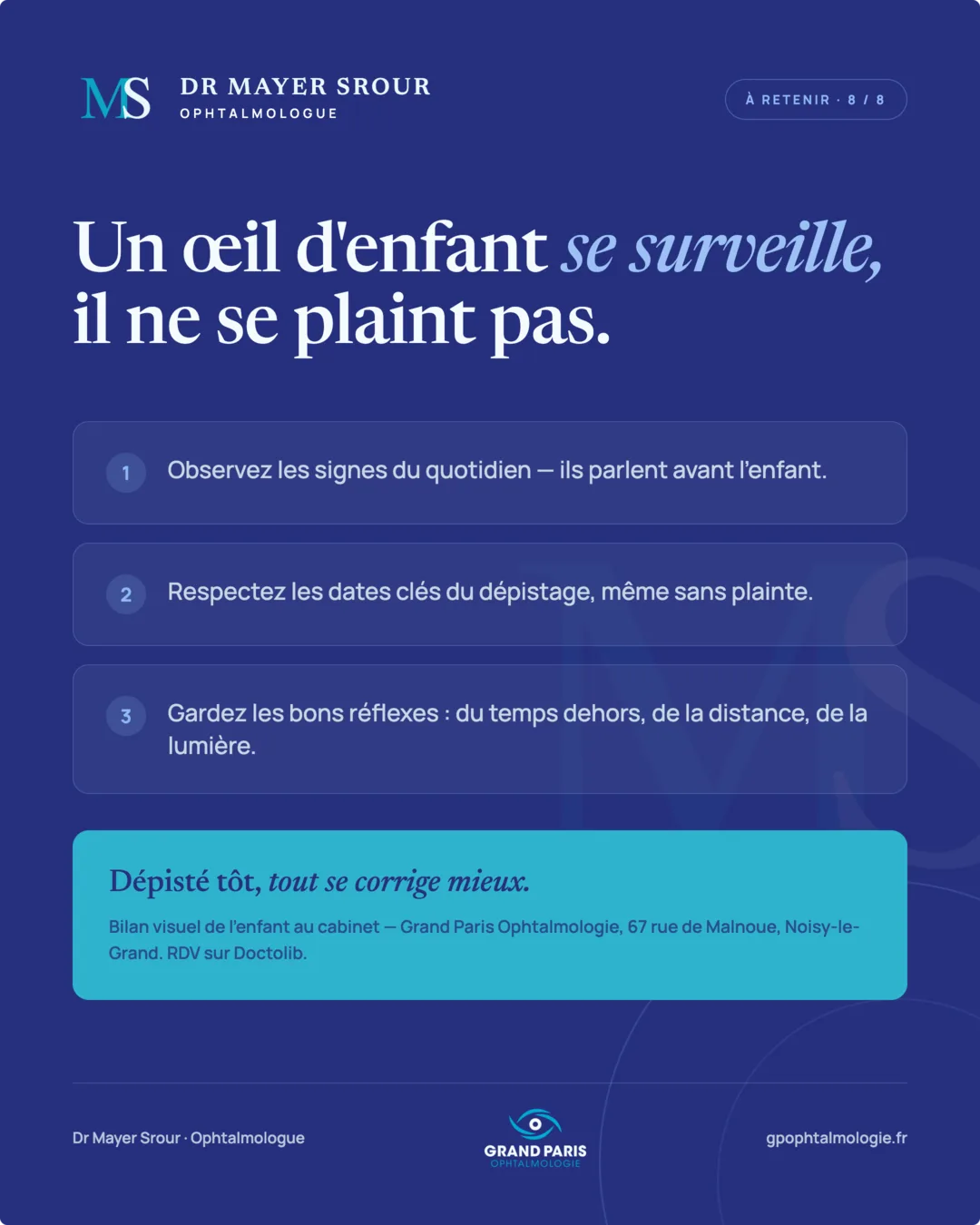
Key points: a child's eyes need watching, because the child will not complain
1 · Watch for everyday signs — they speak before the child does. 2 · Respect the key screening dates, even without any complaint. 3 · Keep up good habits: time outdoors, distance, light.
Caught early, everything is easier to correct. Children's vision assessment at the practice — Grand Paris Ophtalmologie, 67 rue de Malnoue, Noisy-le-Grand.
Going further
This carousel summarises the essentials in a few images. The subject is covered in more depth on the dedicated page of the website: Back to school: having your child's vision checked (full article).